The instinct makes sense. Start small. Build a $400,000 house, keep the risk low, learn the process. It sounds conservative and smart.
The numbers say otherwise.
Jerome Maldonado has been developing real estate for decades. His argument is counterintuitive but backed by math: a $1.5 million home development produces more profit, secures financing more easily, and carries less relative risk than a $400,000 project. Here’s why.
The $400K House: Where Luxury Home Development Profit Goes to Die
Most first-time developers gravitate toward the $400,000 price point because it feels manageable. The problem is the math leaves almost no room for error.
The cost breakdown:
- Land: $50,000–$60,000
- Construction: $267,000
- Closing costs (7%): $28,000
- Loan interest: $20,000
- Total costs: $365,000–$375,000
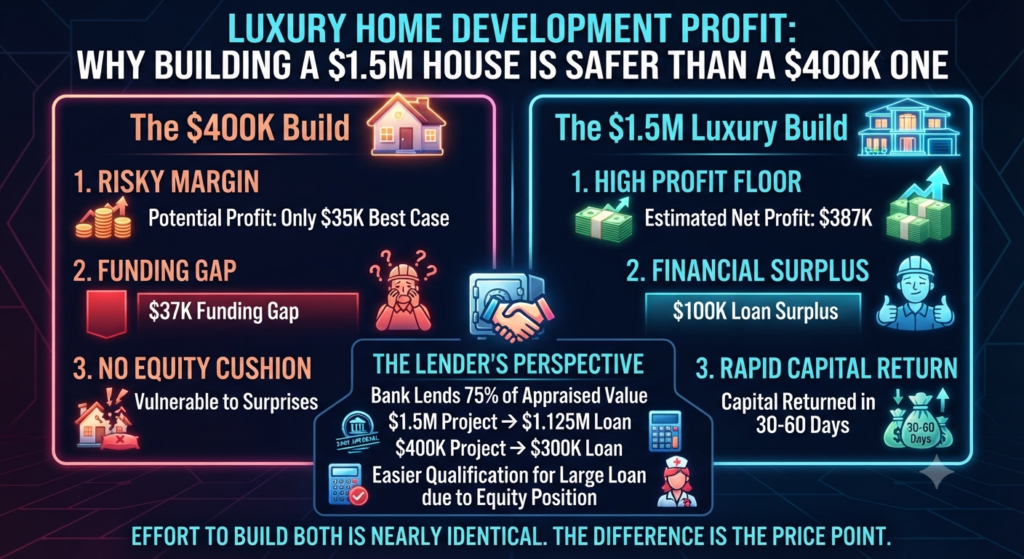
The result: If everything goes perfectly — on time, on budget, full asking price — your net profit is approximately $35,000.
That’s the best case. One HVAC failure, one month of extra holding costs, one price negotiation with a buyer, and your margin evaporates.
The financing problem makes it worse. If the bank lends 75% of the $400,000 appraised value, you get $300,000. But your actual construction costs require $337,000. That $37,000 gap comes out of your pocket — and you’ve built almost no equity cushion to protect you if something goes wrong.
You’re working hard, taking real risk, and walking away with $35,000 if everything goes right. That’s not a real estate development business. That’s a construction job you gave yourself.
The $1.5M House: Where Luxury Home Development Profit Actually Lives
Scale the same framework up to a $1.5 million project and the math transforms entirely.
The cost breakdown:
- Land (25% of sale price): $375,000
- Construction: $613,000
- Closing costs (6% — negotiated lower at this price point): $90,000
- Financing and contingency: ~$55,000
- Total costs: approximately $1,133,000
The result: Conservative net profit of $387,000. Well-managed projects come in at $450,000 or more.
That’s not a best-case scenario. That’s the floor.
The financing advantage is significant. The bank lends 75% of a $1.5 million appraisal — that’s $1,125,000. Your actual construction costs are approximately $1,023,000. The loan covers everything and leaves roughly $100,000 in cushion. You get your initial capital back within 30 to 60 days of construction start. Done correctly, this becomes a zero-out-of-pocket project.
Run your full development numbers through the House Build Cost Calculator before you finalize any budget. The difference between $135 and $141 per square foot across a 4,500 square foot home is $27,000 — enough to change whether the project cash flows from the loan or requires your own capital.
Why Luxury Home Development Profit Is Easier to Finance Than You Think
Here’s the part that surprises most people: a nurse, a firefighter, or an electrician with stable income may find it easier to get approved for a $1 million construction loan than a $400,000 one.
The reason is equity and liquidity.
On the $400,000 project, there’s almost no equity cushion. If costs run over or the market softens slightly, the bank’s collateral is at risk. Lenders don’t like thin margins.
On the $1.5 million project, the loan-to-cost ratio leaves meaningful equity in the deal from day one. The bank has a comfortable cushion. The borrower has room to absorb surprises. The project looks like a real business with real financial structure — which is exactly what commercial construction lenders want to see.
The income and credit requirements are similar at both price points. What changes is how the lender views the deal’s risk profile. A well-structured luxury development project with strong comps and solid equity is an attractive loan. A thin-margin entry-level build with no cushion is a liability.
According to the National Association of Home Builders, construction lending standards have tightened in recent years — which means projects with stronger equity positions are getting funded while marginal deals are being declined. That trend favors luxury home development profit strategies over entry-level builds.
The Effort Is the Same. The Outcome Isn’t.
Jerome makes one point that reframes the entire conversation: building a $400,000 house and building a $1.5 million house require roughly the same effort.
You still need to find the land. You still go through permitting. You still hire a contractor, manage a draw schedule, handle inspections, and market the finished product. The process is the same. The headaches are similar. The time commitment is comparable.
The difference is the check at the end.
$35,000 for the same process that produces $387,000. The only variable is which price point you chose to work in.
This is why experienced developers stop doing small projects. Not because they started with large ones — most didn’t — but because once they ran the numbers side by side, the case for staying in the entry-level range disappeared.
What This Means for Philadelphia Developers
Philadelphia’s luxury new construction market — Society Hill, Rittenhouse, Fishtown, East Passyunk — consistently produces finished product at $800,000 to $1.5 million and above. The land costs in transitional neighborhoods adjacent to these corridors remain accessible relative to finished values.
The luxury home development profit opportunity in Philadelphia isn’t reserved for established developers with deep pockets. It’s available to anyone who can find the right site, structure the financing correctly, and build to the quality standard the market expects.
The entry point is the land. The financing covers the build. The profit is in understanding which price point actually works — and committing to it fully rather than testing the waters with a project designed to minimize risk but also minimize return.
Not financial advice — just someone doing a lot of research and asking a lot of questions.