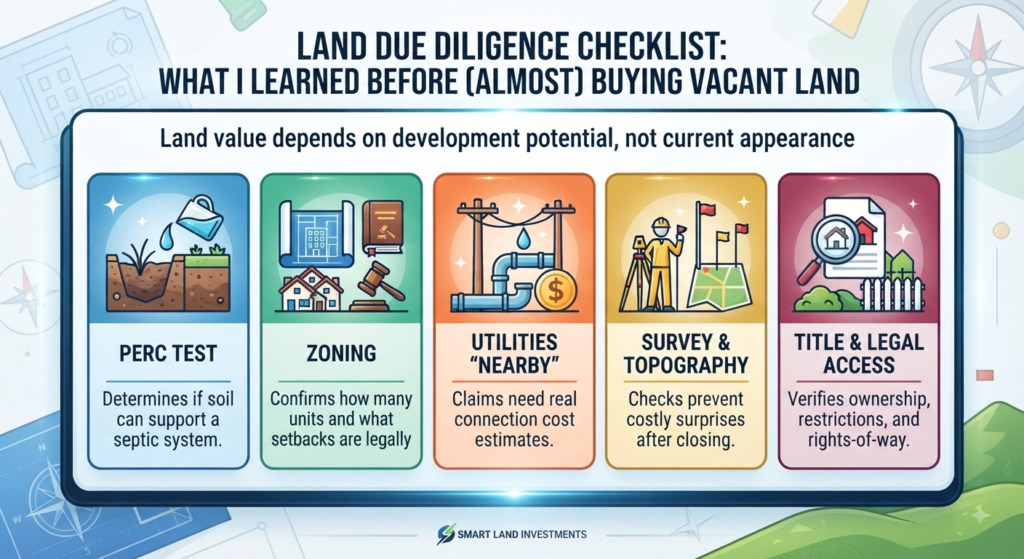
I almost bought a piece of vacant land in Pennsylvania last year based on nothing more than a listing photo and the seller’s word — and that’s exactly why I ended up building my own land due diligence checklist before going any further. If you’re looking at raw land, whether it’s a quarter acre or twenty, the price on the listing means almost nothing until you know what that land can actually support.
Why a Land Due Diligence Checklist Actually Matters
Here’s the thing nobody tells you when you start looking at vacant land: the value isn’t really about what’s there now, it’s about what you’re allowed to build. A lot that can hold one house and a lot that can hold five houses might look identical from the road, but they’re worth completely different amounts of money. Sellers will sometimes talk up the “development potential” of a piece of land like it’s a given fact, when really it’s just a guess until someone verifies it on paper. That’s the whole reason a land due diligence checklist exists — it turns someone’s opinion into something you can actually confirm.
Perc Test and Septic Feasibility
If the land isn’t hooked up to public sewer, this is usually the first thing I’d check now. A percolation test (perc test) tells you whether the soil can actually handle a septic system, and more specifically, whether it can handle a septic system big enough for however many units you’re planning. I didn’t know this at first, but bad soil can straight up kill a development plan before it even starts — no amount of good zoning fixes a lot that can’t pass a perc test.
Zoning and Permitted Uses
This is the part of the land due diligence checklist I’d never skip now. You need to know exactly what the current zoning allows — how many units per lot, minimum lot size, and frontage requirements (how much of the lot has to touch a public road). A seller telling you “you could probably build three units here” isn’t the same as the township telling you that in writing.
Access and Road Maintenance
Does the land actually touch a public road, or does it rely on a private drive or a deeded right-of-way through someone else’s property? This one’s sneaky because a private road might look totally normal on a drive-by, but it may not legally count as road frontage for permitting purposes. I’ve read about deals falling apart at the last minute over exactly this.
Utilities: What “Nearby” Really Means
Water, sewer, electric, gas, fiber — “utilities are nearby” is one of those phrases that sounds reassuring and means almost nothing. Nearby doesn’t tell you the connection cost, and that number can be the difference between a good deal and a money pit. Before I’d move forward on land now, I’d want an actual connection estimate, not just a general sense that utilities exist somewhere on the street.
Topography and Site Constraints
Slope, flood zones, wetlands, and rock outcroppings can all quietly blow up a construction budget. A lot that looks flat and buildable in photos might sit on a grade steep enough to require expensive site work, or worse, sit partially in a flood zone that limits what you can build at all.
Survey and Legal Boundaries
An up-to-date survey tells you the real boundary lines, the real square footage, and whether anyone else has an easement across the property that could limit what you build. This is one of those steps that feels optional until it isn’t — an old or missing survey has caused more than a few deals I’ve read about to fall apart during due diligence.
Using the Land Due Diligence Checklist to Renegotiate
Here’s where all this actually pays off. If the perc test comes back bad, or zoning doesn’t match what the seller claimed, that’s real leverage — not just for a price cut, but sometimes for asking the seller to fix the issue before closing. If someone’s asking a premium because of “development potential,” it’s fair to ask for the paperwork behind that claim: engineer reports, approved septic designs, anything documented. And if you’re not ready to fully trust the numbers yet, a contingency clause tied to passing a perc test or getting permits approved can protect you without killing the deal.
My Land Due Diligence Checklist Action Steps
If I were doing this today, here’s the order I’d go in:
- Order a current survey, and ask the seller for any existing ones on file
- Hire a local civil engineer to check topography and drainage
- Call the city or county planning department directly and ask about zoning and subdivision rules
- Physically go see the land — road condition and surroundings tell you things photos never will
None of this replaces professional advice, but according to the EPA’s guidance on septic systems, soil and site conditions are one of the biggest factors in whether a system will even work — which tells you how much weight that one test alone can carry. If you’re running numbers on a potential land deal, my land potential analyzer can help you sanity-check whether the math even makes sense before you spend money on surveys and engineers.
Not financial advice — just someone doing a lot of research and asking a lot of questions.