I used to think subdividing land was just a paperwork problem — draw a line, file it with the county, done. Then I started reading about land subdivision mistakes that cost people way more than a filing fee, and realized the actual value of a split lot depends on things most people never think to check before they start.
Why Land Subdivision Mistakes Happen Before You Even Break Ground
Most land subdivision mistakes I’ve read about don’t happen during construction — they happen at the planning stage, when someone assumes a lot’s value is obvious just from looking at it. In Bucks and Montgomery County, where a lot of the land still has trees, slope, and irregular access, what looks like a messy overgrown parcel can actually hide the most valuable part of the property.
Mistake 1: Clearing Everything Instead of Working With What’s There
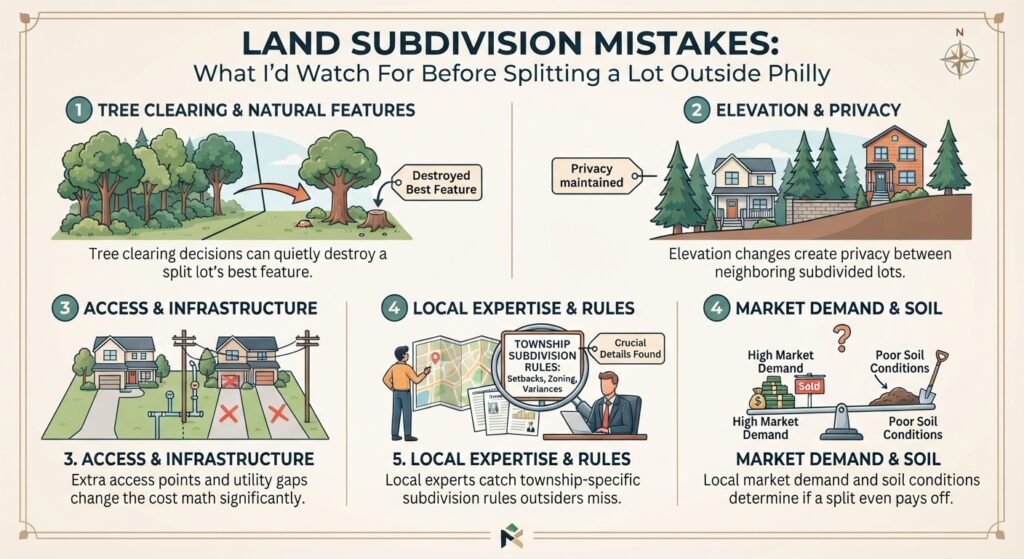
One of the more avoidable land subdivision mistakes is treating every tree on a lot the same way. Not all trees add the same value — some are worth clearing for a building pad, and some are worth keeping as a privacy buffer or a landscaping feature that makes a split lot feel less like a subdivision and more like its own private setting. Clearing a whole parcel flat might look easier on paper, but it usually strips out the exact feature that would have made one of the new lots sell for more.
Mistake 2: Ignoring Elevation and Sightlines Between Lots
A common land subdivision mistake outside a dense city grid is treating flat and sloped lots as interchangeable. Elevation changes between two split lots can create real privacy — enough that neighboring houses don’t end up staring straight into each other’s windows. Skipping this consideration can mean two houses that are technically compliant with setback rules but still feel uncomfortably close once they’re built.
Mistake 3: Not Accounting for Access Points
If a parcel already has two points of access instead of one, that’s worth factoring into how you split it — it’s a genuine advantage that can shape which portion of the land becomes more valuable after subdivision. One of the land subdivision mistakes I see discussed a lot is splitting a lot in a way that leaves one half landlocked or dependent on a shared driveway that later becomes a headache between neighbors.
Mistake 4: Assuming Public Water and Sewer Are the Only Option
Closer to Philadelphia proper, public water and sewer are usually a given. But once you’re further out into Bucks or Montgomery County, that’s not always true, and it’s a land subdivision mistake to assume every new lot can just tie into the same utility line without checking capacity. A private well or an alternative water solution might be necessary for one or both lots, and that changes the cost math significantly before you ever get to construction.
Mistake 5: Not Researching What the Local Market Actually Wants
A subdivision only works financially if there’s real demand for what you’re building on the new lots. One of the bigger land subdivision mistakes is splitting a parcel without checking whether the surrounding school district or township actually has a gap in the price range you’re targeting — building something the market doesn’t want is a mistake no amount of good site planning can fix.
Mistake 6: Underestimating How Much Local Soil and Ground Conditions Matter
Ground conditions vary a lot even within the same county, and skipping this step is one of the quieter land subdivision mistakes. Rockier soil can mean higher excavation costs, but it can also mean more stable ground for a foundation later — while the opposite is true for soil that looks easy to dig but shifts over time. This is exactly the kind of thing a local civil engineer catches and a listing photo never will.
Mistake 7: Trying to Do It Without Local Expertise
Every county and township has its own subdivision rules, and one of the most repeated land subdivision mistakes I keep coming across is trying to navigate that alone. A real estate agent, contractor, and lender who already know the local rules in Bucks or Montgomery County can catch problems long before they turn into an expensive surprise.
According to the American Planning Association, subdivision regulations vary significantly by local jurisdiction, which is exactly why a lot that subdivides easily in one township might run into completely different rules a few miles away. If you’re trying to figure out whether a specific parcel is even worth pursuing for a split, my survey timeline tracker can help you map out what a survey and approval process would actually look like before you commit time or money to it.
Not financial advice — just someone doing a lot of research and asking a lot of questions.