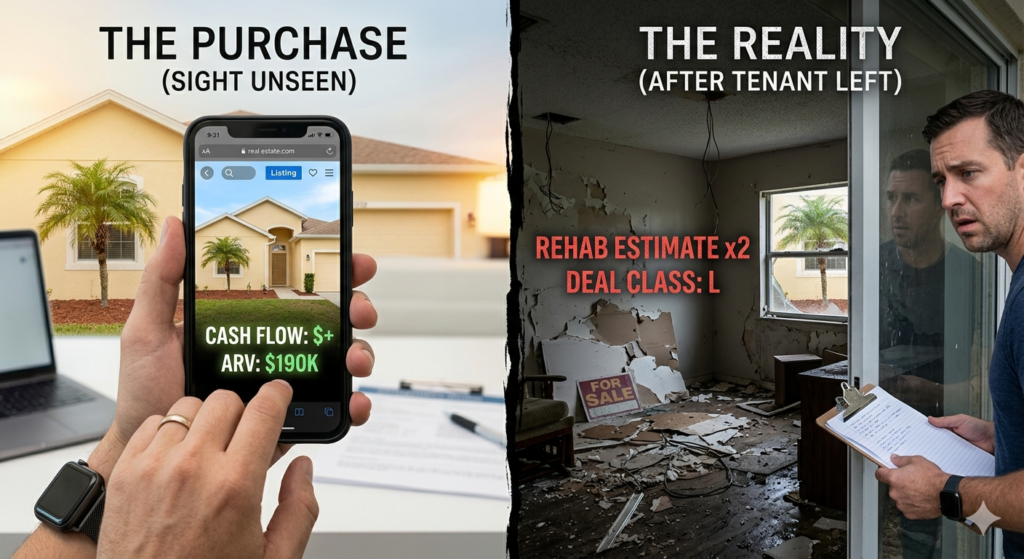
Buying house sight unseen almost cost one investor everything. Not the property itself — but the $30,000 renovation budget that turned into $60,000, on a house he’d never walked through, in a market he’d never visited.
I spent today driving around Philadelphia looking at five properties in person. And after what I saw today — and after coming across this investor’s story — I have a lot of thoughts about what it actually means to know what you’re buying.
The Setup: Buying House Sight Unseen With Positive Cash Flow
In 2024, this investor purchased a property in Florida without ever stepping inside it. Didn’t walk through it. Didn’t visit the neighborhood. Bought it based on the numbers — and the numbers, on paper, looked solid.
The house came with a tenant already in place paying $1,300 a month. The mortgage payment was $650. From day one, the property was cash flow positive by $650 a month. No vacancy, no rehab needed yet, just income coming in.
The plan was simple: let the tenant stay for a year, collect rent, then renovate and either sell or re-rent at a higher rate.
Clean. Logical. Reasonable.
What He Found After Buying House Sight Unseen
A year later, the tenant moved out. The investor flew to Florida to see his property for the first time.
The walls had been ripped out. The interior was gutted. The place was completely destroyed — not from neglect exactly, but from what happens when a property has been occupied by someone who didn’t care and nobody was there to notice.
His words: “What did I just do?”
The only things that didn’t need replacing were the roof and the HVAC system. Everything else — flooring, drywall, kitchen, bathrooms, fixtures — had to go.
The Budget That Doubled
He’d budgeted $30,000 for the renovation. A reasonable number for a cosmetic refresh at that price point.
The actual cost: $60,000. Exactly double.
This is one of the most common stories in real estate investing, and it almost always follows the same pattern. The initial estimate is based on what you can see. What you can’t see — inside the walls, under the floors, behind the fixtures — is where the real costs live. And when a property has been occupied by a difficult tenant with no oversight, what’s behind those walls tends to be worse than expected.
This is the core risk of buying house sight unseen: the gap between what you think you own and what you actually own.
The Final Numbers
| Purchase price | $115,000 |
| Renovation cost | $60,000 |
| All-in | $175,000 |
| Post-renovation appraised value | $190,000 |
| Return | 7.9% |
By the deal classification framework — under 10% is a pass. This deal, after everything shook out, was technically in pass territory.
He didn’t sell. The market had shifted by the time renovations were complete. So he found a new tenant, kept the property, and moved on. The cash flow is still positive. He called it “not a complete L, but definitely an L” — which is about as honest as it gets.
What I Took From This After Driving Philadelphia Today
I spent today looking at five properties in Philadelphia. In person. Driving the streets, looking at neighborhoods with my own eyes.
There is absolutely no substitute for being there.
I saw things today that no listing photo, no Zillow description, and no analysis could have told me. Neighborhoods that looked completely different in person than they did on a map. Streets where I immediately understood why certain properties were priced the way they were. Things you only know when you’re standing on the sidewalk.
The investor in this story was buying house sight unseen from wherever he was sitting. He had a year of positive cash flow before the real picture revealed itself. But he never knew what he actually owned until he walked through the door — and by then, his renovation budget was already set in stone in his head.
The Lessons That Actually Matter
See the property. This sounds obvious. It is obvious. Do it anyway. If you can’t see it yourself, pay someone you trust to walk through it and report back honestly — not just an inspector with a checklist, but someone who will tell you what the neighborhood feels like at 7pm on a Tuesday.
Budget for what you can’t see. A $30,000 rehab estimate on a house that’s been tenant-occupied without oversight is almost certainly optimistic. Add 50% to whatever your first number is and see if the deal still works. If it doesn’t work at $45,000, it probably won’t work when the real bill comes in.
Tenant-occupied doesn’t mean well-maintained. Cash flow on day one is great. But a tenant you’ve never met, in a property you’ve never visited, is flying blind. Get a proper inspection done before closing — even if the tenant is in place.
Have an exit strategy for when the plan changes. His plan was to renovate and sell. The market moved. He pivoted to renting. The deal survived because he had options.
According to BiggerPockets, buying house sight unseen is one of the top five mistakes first-time real estate investors make — and renovation cost overruns from undiscovered damage are the most common consequence.
The Bottom Line on Buying House Sight Unseen
He ended up okay. The property cash flows, the equity is real, and he learned more from this one deal than he probably would have from a smooth transaction that went exactly as planned.
But $60,000 in renovation costs instead of $30,000, on a house he’d never walked through — that’s an expensive education. One that started with skipping the walkthrough.
I drove around Philadelphia today specifically because I know I need to understand what I’m looking at before I make any offers. The numbers matter. The spreadsheet matters. But none of it replaces standing in front of the property and asking yourself: do I actually know what I’m buying?
Use the Flip Checklist Calculator to make sure you’ve covered every due diligence step before you make any offer — sight unseen or otherwise.
Not financial advice — just someone doing a lot of research and asking a lot of questions.