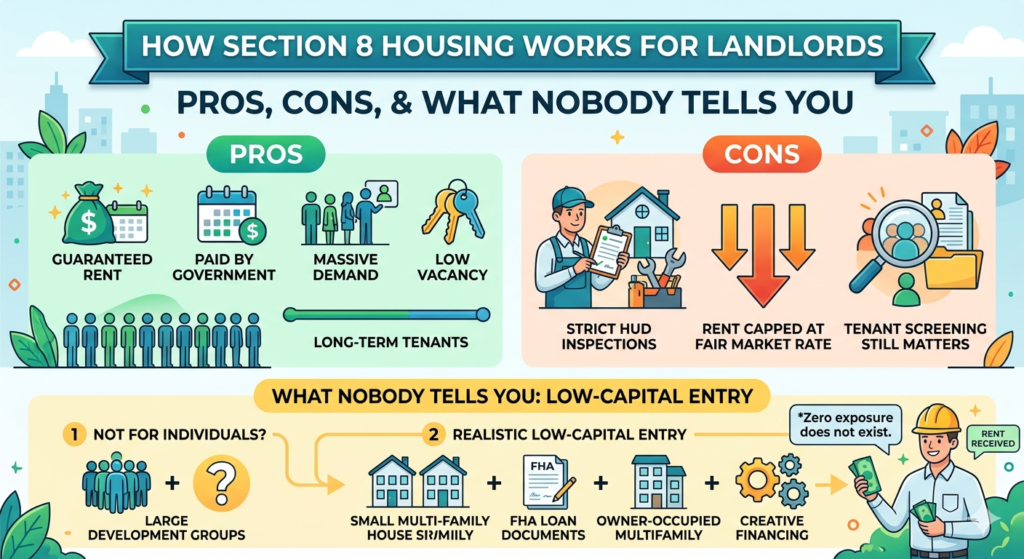
Section 8 landlord investing gets sold as the ultimate low-capital, government-guaranteed income stream. Seven million people on the waitlist. Stable rent checks straight from the government. Little to no money down.
It sounds almost too clean. So I went and actually looked into how this works — because “the government pays your rent” deserves more careful examination than a 60-second video.
Here’s what I found.
What Section 8 Landlord Participation Actually Means
Section 8 is the informal name for the Housing Choice Voucher Program, administered by HUD. It’s a federal program that helps low-income families, elderly, and disabled individuals afford housing in the private market.
Here’s how it works from a Section 8 landlord perspective:
A tenant receives a voucher from their local Public Housing Authority (PHA). The voucher covers a portion of their rent — typically the difference between 30% of their income and the fair market rent for their area. The landlord receives that portion directly from the government, and the tenant pays the rest.
If the fair market rent for a two-bedroom in your area is $1,400 and the tenant’s 30% share is $400, the PHA sends you $1,000 every month — directly, reliably, on time.
That’s the part that gets highlighted in the videos. And it’s real.
The 7 Million Number
Yes, approximately 7 million people are on Section 8 waitlists across the country. In some cities, the waitlist has been closed for years — meaning no new applicants are even being accepted.
What that tells you as a Section 8 landlord: demand for affordable rental housing is not going away. If you own a property that’s approved and you have a good tenant, turnover is low and demand is high. These tenants often stay for years because finding another approved unit is not easy.
Vacancy is expensive. Long-term tenants who pay on time are valuable — even when part of that payment comes from the government.
How You Actually Make Money as a Section 8 Landlord
The business model is straightforward:
You buy a rental property. You apply to your local PHA to become a Section 8 landlord — this involves an inspection to make sure the property meets HUD’s Housing Quality Standards. Once approved, you rent to a voucher holder. The PHA pays their portion directly to you every month.
The rent you can charge is tied to the PHA’s Payment Standard for your area. You can’t charge dramatically above market, but you don’t have to worry about chasing rent payments from a tenant who’s struggling.
The “Little to No Capital” Claim — What’s Actually Going On
This is the part that needs unpacking.
Option 1: Government and State Financing Programs Programs like Low-Income Housing Tax Credits (LIHTC), HOME Investment Partnerships, and Community Development Block Grants can fund acquisition and renovation of affordable housing properties. The catch: these programs are primarily aimed at nonprofits, housing developers, and experienced operators — not individual investors buying their first rental.
Option 2: NACA or Low Down Payment Loans If you’re buying a small multifamily (2–4 units) as an owner-occupant and renting to Section 8 tenants, you can use low down payment programs like NACA or FHA loans. That’s the low-capital entry point that actually makes sense for individual investors.
Option 3: Creative Financing Some Section 8 landlord investors acquire properties through seller financing or subject-to deals. These strategies exist but require deal-finding skills and negotiation experience.
The honest reality: “No capital” usually means someone else’s capital — a loan, a program, a partner. There is no strategy where you acquire real property with genuinely zero financial exposure.
The Section 8 Landlord Pros Nobody Argues With
Guaranteed rent payment. The government portion comes in on time, every month, regardless of what’s happening in the tenant’s financial life.
High demand, low vacancy. With millions on waitlists, approved Section 8 units don’t sit empty long.
Longer tenancies. Voucher holders tend to stay because moving means finding another approved unit — which is hard. Stable, long-term tenants reduce your turnover costs significantly.
Predictable income. The PHA sets payment standards annually. You know what you’re getting.
The Section 8 Landlord Cons Nobody Leads With
Inspection requirements are strict. Before you can rent to a Section 8 tenant, your property must pass a Housing Quality Standards inspection. Items that might slide in a regular rental — a broken window latch, peeling paint, a non-functioning outlet — will fail. You may need to invest in repairs before you ever see a rent check.
Annual inspections. The PHA inspects Section 8 units annually. You have to maintain the property to their standards consistently.
Rent is capped at fair market rate. In appreciating markets where rents are rising fast, your Section 8 rent may lag behind what you could charge on the open market.
Tenant screening still matters. The voucher guarantees the rent subsidy — it doesn’t guarantee a good tenant. You still screen for rental history, references, and behavior.
According to HUD.gov, Section 8 landlord participation has declined in some markets precisely because landlords underestimated the inspection requirements and property maintenance standards — going in with clear expectations prevents this.
Does Being a Section 8 Landlord Make Sense in Philadelphia?
Philadelphia has a significant Section 8 population and an active PHA. Fair market rents in the Philadelphia area for a two-bedroom have been in the range of $1,400 to $1,600 depending on the zip code.
For a Section 8 landlord buying in neighborhoods where market rents are at or near those levels, this can work well. The guaranteed payment and high demand are real advantages in a city where tenant turnover and vacancy can be expensive.
The inspection requirements are actually a benefit in disguise — they force you to maintain the property, which protects your asset long-term.
Use the Multi-Unit Cash Flow Calculator to model your Section 8 landlord cash flow before you buy — including PHA payment standards for your specific Philadelphia zip code.
Not financial advice — just someone doing a lot of research and asking a lot of questions.