Strip mall investing is one of those topics I didn’t expect to get obsessed with. I came across two completely different stories recently — one about a busted-up retail strip in Florida, and one about a guy who walked away from Airbnb and built a $20 million hospitality portfolio. On the surface they look unrelated. But the core lesson is identical: you make your money when you buy, and you make more when you think differently about how to operate.
Here’s what I learned from both.
Strip Mall Investing 101: The Pyramid Plaza Story
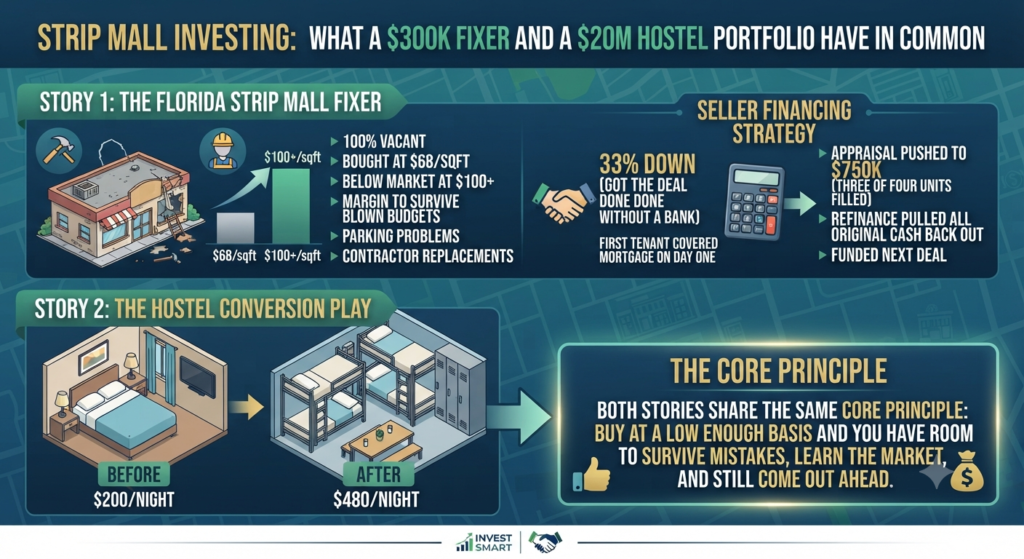
A 4,500 square foot strip center in Hudson, Florida. Four units. 100% vacant. Roof caving in. Air conditioning units stripped by thieves. By every measure, it was a disaster property nobody wanted.
It sold for $300,000 — about $68 per square foot at a time when comparable properties in the area were trading above $100 per square foot.
That low basis is what made everything else possible in this strip mall investing story.
The buyer used seller financing — 33% down in cash, the rest carried by the seller directly. No bank. No traditional loan. Just a negotiated deal with a motivated seller who wanted out.
Then the problems started.
Parking didn’t meet city requirements, which meant certain tenants — restaurants especially — couldn’t legally operate there. The renovation budget was $115,000. Actual cost came in over $150,000. Multiple contractors had to be fired and replaced. Multiple leasing brokers came and went.
This is the part of strip mall investing that nobody talks about enough. Things go sideways. Budgets blow up. Deals take longer than you planned.
But here’s the thing: when the first tenant signed — a smoke shop — the rent covered the mortgage and operating costs entirely. Break-even on day one of occupancy. From that point, every additional tenant was pure upside.
With three of four units filled, the building appraised at $750,000. The fourth unit still vacant. The math on strip mall investing suddenly looked very different from where it started.
After the appraisal came in, a refinance pulled the original cash investment back out entirely. The building was now effectively owned with none of the investor’s money left in the deal — and that capital went straight into the next acquisition.
That’s the flywheel. That’s why strip mall investing at a low basis changes the entire risk profile of a deal.
What a $20M Hostel Portfolio Has to Do With Strip Mall Investing
Different asset class, same principles.
Michael Russell started in residential, flipped into short-term rentals in Hawaii, then made a move that most people would find strange: he stopped buying Airbnbs and started buying hostels.
His reasoning was straightforward. Airbnb has scaling problems — logistics get messy across multiple properties, regulations in places like Hawaii keep tightening, and residential comps cap your upside. Hostels operate on commercial valuation. Increase the income, increase the asset value. Same NOI formula that drives strip mall investing.
But the part that really got me was the density math.
A standard 400-500 square foot hotel room generates around $200 per night. Convert that same room into a 6-bed dormitory at $80 per bed and you’re generating $480 per night from the same four walls.
And the vacancy protection is built in. If that hotel room sits empty, revenue is zero. If the hostel dorm runs at 50% occupancy — just 3 beds filled — you’re already at $240 per night. More than the hotel generates at full occupancy.
The operational innovation that made his portfolio work wasn’t just the density play. He took the design philosophy from high-end Airbnb — art, lighting, social atmosphere — and applied it to hostel properties that everyone else was running as bare-bones budget accommodations. Nightly rates went from $32 to $80. The same asset, repositioned.
He bought his first properties during COVID when hospitality assets were priced at panic levels. Low basis again. Same principle as the Florida strip mall.
The Real Lesson in Strip Mall Investing (and Everything Else)
Both of these stories are about the same thing.
Strip mall investing works when you buy distressed assets at prices that give you enough margin to survive the mistakes — and there will be mistakes. The Pyramid Plaza investor blew his renovation budget by $35,000, dealt with parking restrictions that limited his tenant options, and cycled through multiple brokers and contractors. None of it mattered because he bought at $68 per square foot when the market was $100 plus.
The hostel investor watched Airbnb regulations tighten around him, navigated a global pandemic that shut down travel, and operated in one of the most operationally complex corners of real estate. None of it stopped him because he bought at distressed prices and operated differently than everyone else in the space.
You make your money when you buy. The operation determines how much you make after that. But if the basis is right, you have room to figure it out.
I’m still learning all of this — haven’t pulled the trigger on anything commercial yet. But the more I study strip mall investing and adjacent strategies, the more I’m convinced that the real edge isn’t some secret formula. It’s discipline at the buy.
Not financial advice — just someone doing a lot of research and asking a lot of questions.