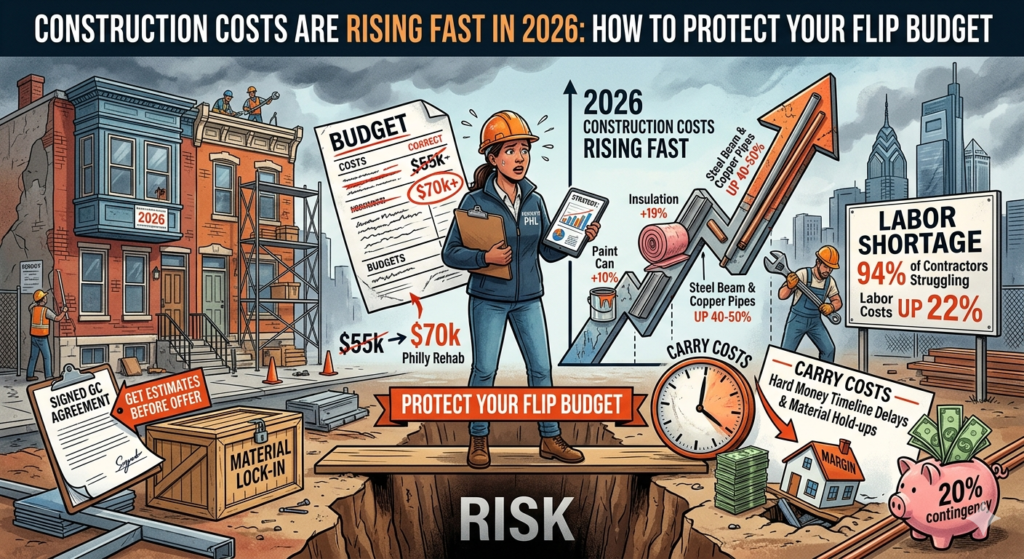
I’ve been running numbers on Philadelphia properties for months now, and something keeps throwing off my renovation estimates: by the time I sit down to actually price out a project, the material costs I researched two weeks ago are already wrong.
This isn’t bad luck. It’s the market in 2026.
Between geopolitical instability driving up energy costs, ongoing tariffs on imported materials, and a labor shortage that isn’t going away anytime soon, construction costs are moving fast — and in one direction. If you’re planning a flip or new construction project this year, here’s exactly what’s going up, by how much, and what you can do about it.
The Big Picture: What’s Driving Costs Up
As 2026 begins, U.S. construction pricing remains defined by persistence rather than resolution. Tariffs, labor shortages, elevated interest rates, and reconfigured supply chains continue to exert upward pressure on costs. Griffin Funding
Since early 2020, construction input prices have increased more than 43% according to the U.S. Bureau of Labor Statistics. Fabricated structural metal products rose over 63% during that period. Griffin Funding
Energy costs are a major factor that doesn’t get enough attention. When oil prices spike — whether from Middle East instability, tariffs, or supply disruptions — almost every building material gets more expensive. Building material prices are up 3.5% year over year, the largest annual increase since early 2023, with metal products continuing to stand out as the biggest movers.
And here’s what makes 2026 especially tricky for investors: the central issue is no longer whether costs will rise, but how unevenly and unpredictably those increases will appear across markets, trades, and material categories. Griffin Funding
Translation: you can’t just add a flat 10% contingency and call it a day. You need to know which specific materials are moving and plan accordingly.
What’s Actually Going Up — Category by Category
Paint
One of the biggest surprises for flippers right now. Painting costs are up approximately 10% year over year, leading all interior finish categories. Sherwin-Williams announced a significant price increase that was notable enough to prompt Wells Fargo to downgrade the stock. Paint seems like a small line item until you’re doing a full interior repaint on a 1,500 square foot Philadelphia rowhouse — then it adds up fast. HotPads
Drywall / Gypsum Board
Gypsum board is up about 8% year over year, and Gordian’s experts anticipate further volatility in the gypsum market due to supply-side concerns. The reason drywall tracks energy costs so closely is simple: drywall is heavy with slim profit margins, and increased transportation costs directly raise material prices. CertainTeed announced across-the-board increases on all their wallboard products that pushed prices significantly higher. HotPadsLS Building Products
Insulation
Fiberglass insulation costs posted double-digit year-over-year growth for three straight quarters, up 18.49% since Q2 of 2025. The current cost of insulation is $0.64 per square foot, up 19.14% year-over-year. If you’re doing any gut rehab — and most Philadelphia rowhouses require it — insulation is a line item you cannot ignore. HotPads
Metals (Steel, Aluminum)
The federal government’s use of Section 232 tariffs on imported steel and aluminum expanded significantly in 2025 and into 2026, with rates reaching as high as 50% on many products. Aluminum prices climbed roughly 40% in the United States following tariff increases. This hits everything from structural framing to windows, doors, and HVAC components. Capstone Capital
Windows and Doors
Cornerstone Building Brands — one of the largest window and door manufacturers in the country — announced price increases of 3% to 8%. On a full house, that’s real money.
Carpet and Flooring
Mohawk, the country’s largest flooring manufacturer, announced an 8% price increase. For flippers doing LVP or carpet throughout, budget accordingly.
Labor — The Wildcard
Material costs get the headlines, but labor might be the bigger problem. Approximately 439,000 additional workers were needed in 2025, with nearly 500,000 required in 2026 to meet projected demand. About 94% of contractors report difficulty filling open positions. Griffin Funding
Skilled labor costs increased 22% in construction-heavy states over recent years, and this trend continues into 2026. Labor typically represents 50% to 70% of your total project cost. LS Building Products
When contractors are hard to find, the good ones can charge more. And they do.
What This Actually Means for a Philadelphia Flip
Let me put this in concrete terms for a typical Philadelphia rowhouse — 3 bed, 1.5 bath, 1,200 square feet, full rehab.
A renovation budget that would have been $55,000 eighteen months ago might now realistically be $65,000-$70,000 when you account for current material and labor costs. That’s a $10,000-$15,000 swing — and it comes directly out of your profit margin.
On a deal where you projected a $40,000 profit, that’s suddenly a $25,000-$30,000 profit. Still workable, but the math looks very different. And if you built in no contingency, you’re potentially underwater.
This is why your ARV estimate needs to be conservative and your renovation budget needs to be current, not based on numbers from six months ago.
How to Protect Your Budget — Practical Strategies
1. Get GC estimates right before you make an offer — not after
Don’t use your own numbers to decide if a deal works and then find a GC later. Walk the property with a GC during your inspection period, get a real estimate with current material costs, and use that number in your calculation. A deal that pencils at $55k in rehab doesn’t pencil at $68k.
2. Lock in material prices early
Larger contractors are locking in supply agreements months in advance and negotiating bulk pricing to stabilize costs. If your GC can order key materials — drywall, windows, flooring — before prices move again, that’s worth doing even if it means paying a bit earlier. Capstone Capital
3. Build a real contingency — not 5%
The standard “add 10% contingency” advice doesn’t cut it in 2026. Budget an extra 15-20% beyond your estimated construction costs for contingencies, as 32% of custom home projects exceed initial budgets by at least 10%. For older Philadelphia rowhouses with unknown conditions behind the walls, 20% is smarter. LendSure Home Loans
4. Focus on cosmetic flips where possible
The biggest cost increases are hitting structural materials — insulation, drywall, metals. If you can find a property that needs mostly cosmetic work (paint, flooring, fixtures, kitchen refresh) rather than a gut job, your exposure to rising material costs is significantly lower. The margins are thinner on fully renovated properties, but the risk is also lower.
5. Price your ARV conservatively
Rising construction costs affect every other investor too — which means some are going to overpay for properties or underestimate renovation costs and end up cutting corners to get out. That can drag down comps in your area. Price your exit conservatively.
6. Know your hard money timeline
The construction industry is bracing for significant changes as tariffs reshape the market landscape. Delays in materials can extend your renovation timeline — which extends the time you’re paying hard money interest. A project you planned to flip in 5 months might take 7 if your windows are backordered. Build that into your carrying cost calculation. Griffin Funding
The Honest Bottom Line
I’m not saying don’t do deals in 2026. The Philadelphia market still has real opportunity — prices are still relatively low compared to other major cities, and demand for renovated housing is there.
But the era of “rough estimate plus 10% and you’re fine” is over. The investors who succeed this year will be the ones who do their homework on current material costs, work with GCs who are honest about timelines, and build enough cushion into their budgets to absorb the surprises that always come up in older Philadelphia housing stock.
Run your numbers carefully. Then run them again.
Use the calculator below to build out your full flip budget — including current material costs and contingency — before you make an offer.