Construction Loan Real Estate: How to Build and Profit with a Construction Loan
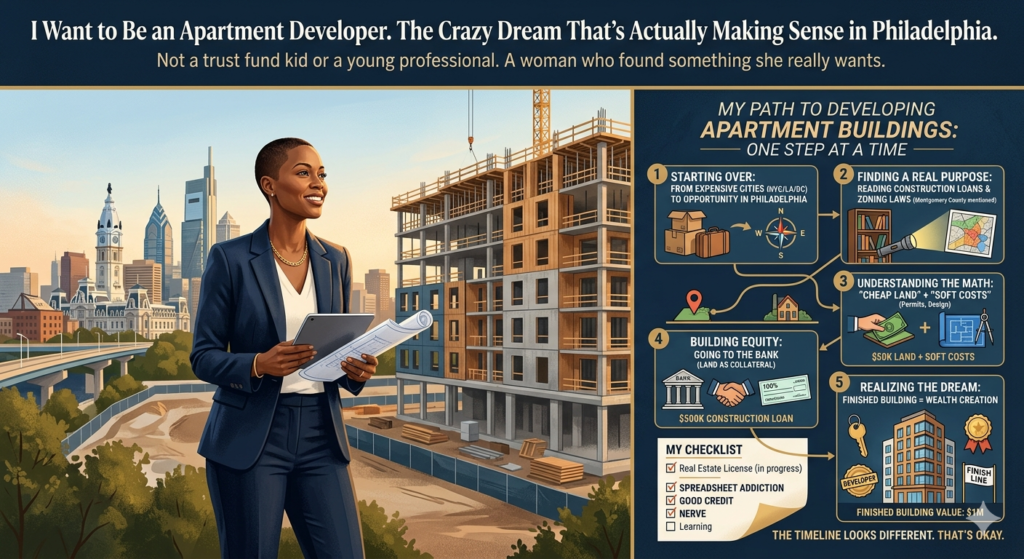
Let me just say it out loud: my dream is to develop apartment buildings.
I’m not a 25-year-old with a trust fund and a real estate degree. I’m a woman who spent years living in expensive cities — LA, New York, New Jersey, DC — paying someone else’s mortgage every single month, not really thinking about what I actually wanted from life.
I moved to Philadelphia because it made financial sense. Between New York and DC, cheaper than both, and I needed to breathe. I didn’t come here with a plan. I came here with not much.
But somewhere in the process of starting over, I found something I actually want. Like really want. Not “that would be nice someday” want — the kind that keeps you up at night reading about construction loans and zoning laws and land costs in Montgomery County.
I want to build things. Real things. Apartment buildings that people actually live in.
Is that crazy? Maybe. I’m not exactly at the starting line most people imagine for construction loan real estate. But here’s what I’ve learned about starting late: you stop wasting time on things that don’t matter. Every hour I spend studying this stuff feels different from anything I’ve done before. It doesn’t feel like work.
So when I came across this strategy, I couldn’t stop thinking about it.
Then things fell apart. And when they did, I had to start over.
How Construction Loan Real Estate Actually Gets Financed
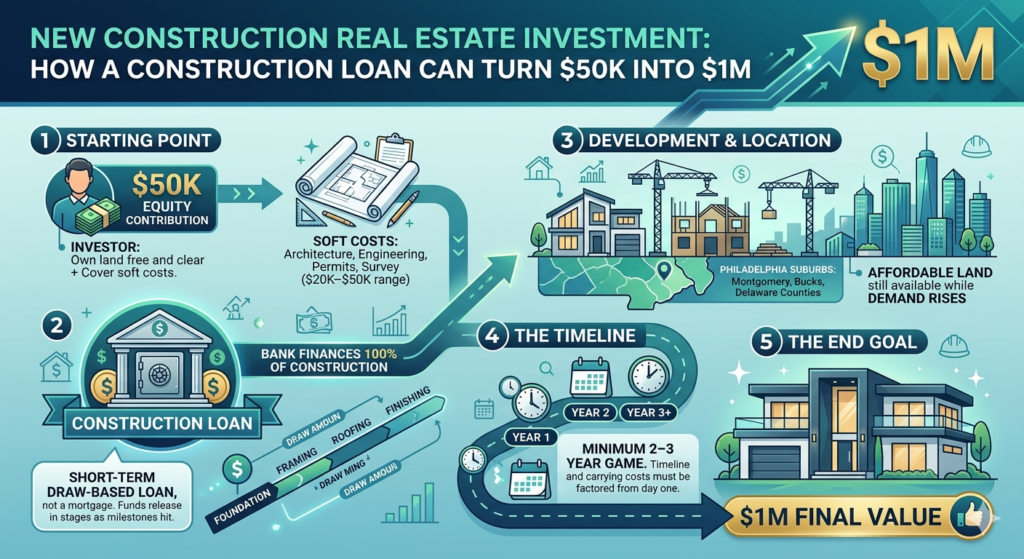
The idea is simple on paper. Find cheap land in a good area. Buy it using as little of your own cash as possible. Handle the permits, the engineering, the architectural plans — the “soft costs.” Then go to the bank.
Because you own the land outright with no mortgage on it, the bank is far more likely to finance 100% of your construction costs. That’s the key insight behind construction loan real estate that most beginners never hear about.
The example that keeps playing in my head: $50K in land and soft costs. $500K construction loan from the bank. Finished building worth $1M.
That’s not a flip. That’s building something from nothing. That’s what developers do.
What soft costs actually are (and why they matter)
Before you even think about breaking ground, there’s a whole layer of expenses most people don’t account for. These are called soft costs — and in construction loan real estate, they can make or break your deal before construction even starts.
Soft costs typically include:
Architectural drawings and design fees. Before a bank will even look at your construction loan application, you need stamped plans. These aren’t cheap — expect $5,000 to $30,000+ depending on the size and complexity of the project.
Engineering reports. Structural, civil, geotechnical — depending on your site, you may need multiple engineers involved before permits get approved.
Permit fees. Philadelphia and the surrounding suburbs each have their own permitting process. Fees vary, but budget for delays too — permits rarely come through on the timeline you expect.
Survey costs. If you’re buying raw land, you need a survey. Period. No lender will touch a construction loan real estate deal without one.
Title and legal fees. Getting clean title on land, especially in Philly or its suburbs, can require more legal work than a standard home purchase.
When you add it all up, soft costs on a modest project can run $20K–$50K before a single shovel hits the ground. That’s real money — but it’s also your equity position. It’s what you’re bringing to the table instead of a down payment.
How the draw process works
A construction loan is not a mortgage. It’s a short-term loan — usually 12 to 18 months — that funds the build in draws. Meaning the bank doesn’t hand you $500K on day one. They release money in stages as construction milestones are hit, verified by inspections.
Here’s how lenders typically think about a construction loan real estate deal:
You own the land free and clear → the bank counts that as your equity contribution. You’ve completed soft costs → permits pulled, plans stamped, engineering done. The bank funds the hard costs → foundation, framing, mechanical, finishes.
When the project is complete, you either sell the building and pay off the construction loan, or refinance into a permanent loan and hold it. According to the FDIC, construction lending has specific underwriting standards that differ significantly from standard residential mortgages — worth understanding before you walk into a bank.
The interest during construction accrues while you build. I ran the numbers on how much construction loan interest can eat into your profit in a previous post — the difference between a 6-month and 12-month build timeline can cost you $12,000 or more.
Why Philadelphia suburbs make sense for construction loan real estate right now
I’ve lived in enough expensive markets to know what early looks like. The suburbs around Philadelphia — Montgomery County, Bucks County, Delaware County — still have affordable land. Not forever, but right now.
Builders are already moving out there. New residential permits in suburban Philadelphia counties have been ticking up steadily. The demand is there. The land is still priced like it isn’t.
For a construction loan real estate strategy built around buying cheap land and building on it, that window matters. It’s not going to stay open indefinitely.
Why Construction Loan Real Estate Takes Longer Than You Think
Here’s the thing that the TikTok version leaves out: it’s slow. Like, really slow.
From land purchase to breaking ground, you’re looking at 6–12 months minimum just for soft costs and permitting — and that’s if nothing goes wrong. Then add 12–18 months of construction. Then the sell or refi decision.
You’re playing a 2–3 year game, minimum. That’s not a bad thing — it just means your capital is tied up, your timeline needs to be realistic, and your numbers need to work even if the market shifts a little.
I used the Pre-Build Cost Estimator to map out a rough project scenario for a small multifamily in Montgomery County. The numbers were humbling but not impossible.
Am I ready to do this tomorrow? No. But here’s where I am.
I’m still getting my real estate license. I’m still learning. I’m genuinely a little scared of the scale of it — the moving parts, the contractors, the permits, the timeline.
But I’m also someone who used to think dreams had expiration dates. That you had to have everything figured out by a certain age, or it was too late.
I don’t believe that anymore.
Philadelphia is changing fast. The land outside the city is still affordable. Construction loans exist. And I have good credit and a spreadsheet addiction and apparently a lot of nerve.
Construction loan real estate isn’t a strategy reserved for big developers. The timeline just looks different than most people expect.
And honestly? That’s okay.
Not financial advice — just someone doing a lot of research and asking a lot of questions.