How to Flip a House in Philadelphia: A Step-by-Step Guide for Beginners
I drove around Philadelphia yesterday looking at houses.
Not casually. Like, actually looking — pulling up Zillow, writing down addresses, peeking through windows like a total creep. The kind of afternoon where you convince yourself you’re being productive and then get home and realize you have absolutely no idea what to do next.
Because here’s the thing nobody tells you: how to flip a house in Philadelphia is completely different from what you see on HGTV. Finding the house is the easy part. Everything that comes after turns your brain into soup.
So I’m writing this for anyone who’s been in that same driveway, staring at a rowhouse going “okay but… now what?” Here’s the full process, step by step — from “I found a house” to “I just made money on it.”
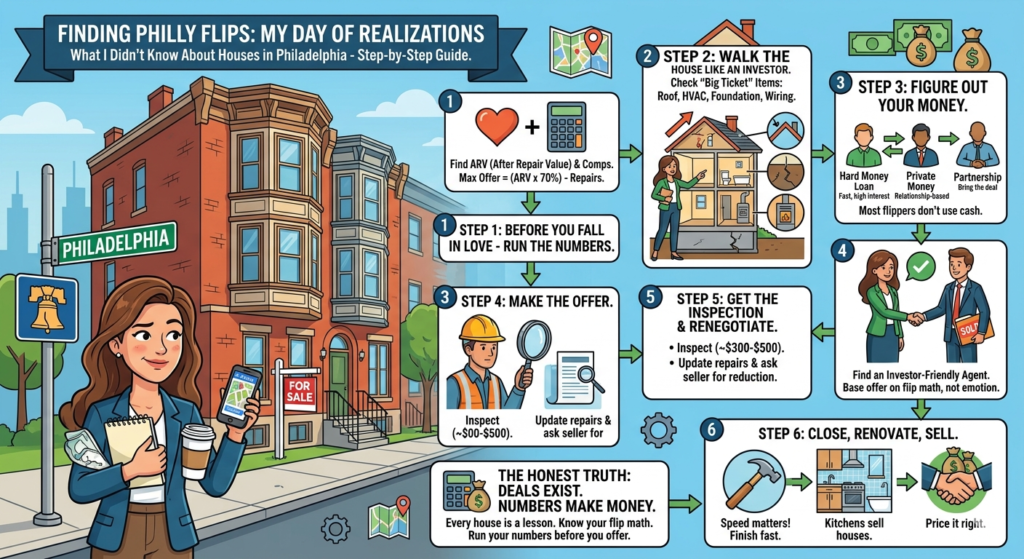
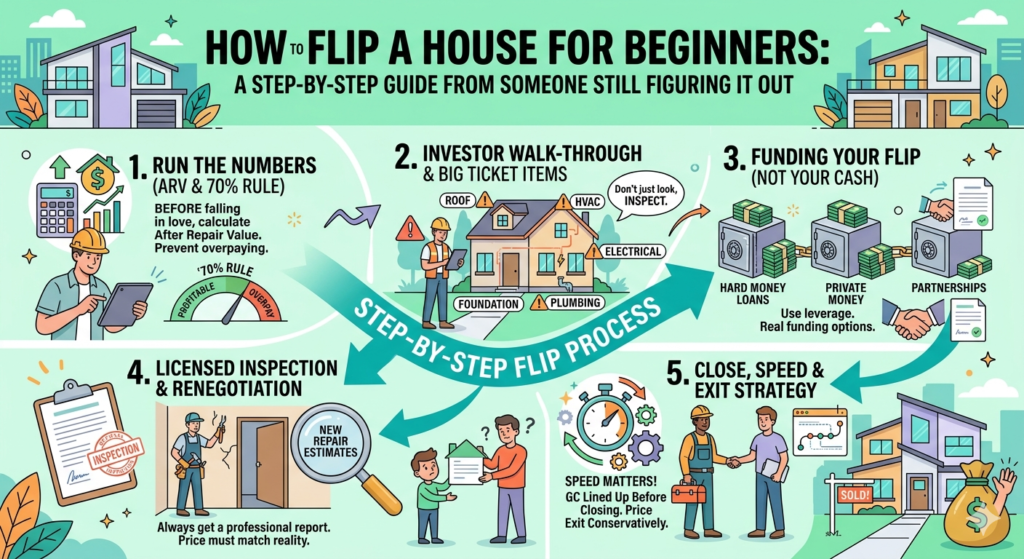
Step 1: Before You Fall in Love — Run the Numbers
I cannot stress this enough. The first thing you need to understand about how to flip a house in Philadelphia: do not get emotionally attached before you know if the deal works.
The first thing you need to figure out is ARV — After Repair Value. What will this house be worth after you fix it up? Look at comparable sales (comps) in the same neighborhood — similar size, similar condition, sold in the last 3–6 months.
Then work backwards using the 70% Rule:
Maximum offer = (ARV × 70%) minus estimated repair costs
So if ARV is $200K and repairs are $30K: ($200K × 0.70) – $30K = $110K max offer
If the asking price is way above that? Walk away. The deal doesn’t work. According to NAR, the majority of failed flips come down to overpaying at acquisition — not bad renovations.
Use the Philly Flip Profit Calculator to run your full numbers before you make any moves.
Step 2: How to Flip a House in Philadelphia — Walk It Like an Investor
When you tour the house, you’re not looking at whether you like the kitchen. You’re looking at how much everything is going to cost. Philly rowhouses have their own specific issues — older electrical, cast iron pipes, shared walls — and you need to know what you’re walking into.
The big ticket items that can kill a flip:
- Roof — replacement runs $8K–$20K+
- HVAC — $5K–$15K
- Electrical — knob-and-tube wiring is everywhere in older Philly rowhouses
- Foundation — if there are cracks, run
- Plumbing — cast iron pipes in older homes can be expensive
Write everything down. Every crack, every stain, every door that doesn’t close right. Use the Flip Checklist Calculator to track issues as you walk — costs add up automatically.
Step 3: Figure Out Your Money
Most people learning how to flip a house in Philadelphia aren’t using their own cash. The most common options:
Hard Money Loan — short term, higher interest, but fast and flexible. They lend based on the deal, not just your income. Great for flips because you’re in and out quickly.
Private Money — a person (friend, family, investor) lends you the money privately. More flexible terms, relationship-based.
Partnership — someone brings the money, you bring the deal and do the work. Split the profit.
Know your numbers before you talk to a lender. Run your borrowing costs through the Hard Money Loan Calculator so you know exactly what you’re walking into.
Step 4: Make the Offer
This is where a good investor-friendly real estate agent is worth their weight in gold. You want someone who understands flip math, not just someone who sells family homes.
When you make the offer:
- Base it on your 70% rule calculation, not emotion
- Include an inspection contingency — this lets you back out if the inspection reveals something catastrophic
- “As-is” offers are more attractive to sellers but riskier for first-timers
- Be prepared to negotiate after inspection
Step 5: Get the Inspection — Then Renegotiate
Hire a licensed home inspector ($300–$500). This is not optional when you’re figuring out how to flip a house in Philadelphia — older housing stock means surprises.
Their report will show you everything wrong with the house. Use it to update your repair cost estimates, go back to the seller and ask for a price reduction, or walk away if the numbers no longer work.
Run your flip profit numbers again with the updated repair costs before you commit.
Step 6: Close, Renovate, Sell
Once you close, the clock starts ticking — especially if you have a hard money loan charging you interest every month.
Move fast on renovations. Get your GC lined up before you close if possible. Get 3 quotes minimum. Don’t hire the cheapest one — hire the one with references and a track record.
Common flip renovations in Philadelphia:
- Kitchen and bathrooms sell houses
- Fresh paint throughout — always
- New flooring
- Curb appeal — first impressions matter in Philly neighborhoods
Price it right when you list. Check comps again. One last run through the Philly Flip Profit Calculator with all final costs plugged in before you list.
The Honest Truth About How to Flip a House in Philadelphia
Yesterday’s drive taught me something. The houses are out there. The deals exist. But this process has a lot of moving parts — and the people who make money on flips are the ones who know their numbers cold before they ever make an offer.
I’m still learning. I’m still figuring this out. But every house I look at is a lesson, and every lesson gets me closer to actually doing this.
If you’re at the same stage I am — curious, a little overwhelmed, driving around neighborhoods with Zillow open — I hope this helped.
Now go run your numbers.
Not financial advice — just someone doing a lot of research and asking a lot of questions.