If you’ve been apartment hunting in Philadelphia recently, you’ve probably seen the signs.
“2 months free!” “3 months free on select units!”
But never on every unit. Always the ground floor facing the construction crane. Always the unit whose view just got blocked by the building going up across the street. Always the ones with a reason.
I’ve been on the other side of this too — moved into a brand new building, got a discount, spent the next several months listening to jackhammers at 7am while the rest of the complex was still being finished. The deal made sense. So did the earplugs.
But there’s a bigger financial strategy behind those signs that most people never think about. It involves something called a construction loan release clause — and once you understand it, you’ll never look at a new development the same way.
The Problem Every Developer Faces
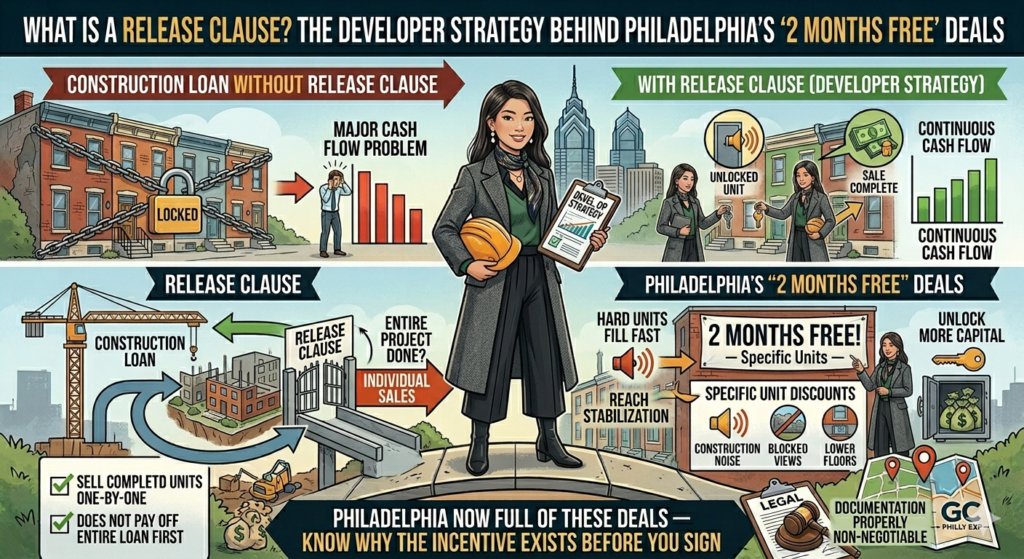
When a developer builds multiple units — say, 14 townhouses or a 20-unit apartment building — they typically take out one large construction loan that covers the whole project.
That loan is secured by all 14 properties as collateral. The bank holds a lien on everything. So even if 6 units are completely finished and ready to sell, the developer can’t just sell them individually and pocket the proceeds. The whole portfolio is locked until the loan is paid off.
For a developer who still has 8 units under construction, this is a serious cash flow problem. Finished units are sitting there generating nothing, while construction keeps burning through capital.
This is exactly where a construction loan release clause changes everything.
What Is a Construction Loan Release Clause?
A construction loan release clause is a provision negotiated into the loan agreement that allows the developer to sell or refinance individual completed properties without paying off the entire loan first.
As each unit gets finished, the bank releases it from the blanket lien — letting the developer sell it, collect the proceeds, and use that money to fund the rest of the build.
Without a construction loan release clause: all 14 properties are locked until everything is done and the full loan is repaid.
With a construction loan release clause: finish unit 1, sell unit 1, use that cash to keep building units 8 through 14. Keep the machine moving.
It’s one of the most important — and least talked about — tools in development finance. And getting a lender to agree to one requires negotiation upfront, before the loan closes. According to BiggerPockets, release clauses are standard in larger development deals but far from automatic — you have to specifically ask for them and negotiate the terms.
Now Back to Those “2 Months Free” Signs
For a rental development, the equivalent of a construction loan release clause is occupancy. Lenders and investors want to see the building stabilized — a certain percentage of units leased — before they’ll refinance or release capital. So the developer’s goal is to get units filled fast.
Easy units fill themselves: good floor, great view, away from noise. Tenants line up. Full price, no incentives needed.
The hard units are different:
Ground floor facing the construction site next door. The unit whose window looks directly into a crane. The floor where the hallways are still being finished. The unit whose “city view” just got blocked by a new building across the street.
Those units sit empty. And empty units cost the developer money every single month — not just in lost rent, but in carrying costs on the construction loan.
So what do they do? Two months free. Three months free on select units. A targeted incentive to fill the hard units fast, hit stabilization, and unlock the next round of capital.
What This Means If You’re the Tenant
I lived this. Took the discount, dealt with the noise. In hindsight it was a rational trade — I knew what I was getting into, and the savings were real.
But here’s what I wish I’d asked before signing:
How much of the building is currently occupied? When is construction on the remaining units expected to finish? Will the work affect my unit’s noise level, natural light, or access? Is the concession on my unit because of a temporary issue — or a permanent one?
A temporarily blocked view during construction is one thing. A permanently blocked view because a building just went up next door is a completely different situation. Know which one you’re signing up for.
What This Means If You’re the Investor
If you’re on the development side — or planning to be — a few things matter here.
Negotiate the construction loan release clause before you close. Once the loan is done, your leverage is gone. Get it in writing upfront that you can sell or refi individual completed units as the project progresses. Standard in larger deals, but not automatic.
Price your incentives strategically. Not every unit needs a discount. Identify which units will be hardest to fill and target concessions there. Offering 2 months free on a unit that would’ve rented at full price anyway is just leaving money on the table.
Know what stabilization means to your lender. Some want 80% occupancy. Some want 90%. Know your target before you start leasing and build your incentive strategy around hitting it efficiently.
Cash flow timing is everything. The whole point of a construction loan release clause — or aggressive lease-up incentives — is to keep capital moving through the project. Every finished unit sitting empty is a drag on the whole operation. Speed of occupancy matters just as much as rental rate.
Philadelphia Right Now
Philadelphia is full of new development — and full of “2 months free” signs as a result. Germantown, Brewerytown, Fishtown, Port Richmond — new buildings are going up across the city, and developers are competing for tenants in a market where supply is increasing faster than some neighborhoods can absorb.
If you’re renting, this is a good moment. The concessions are real and the units are often high quality — just be strategic about which unit you’re taking and why the incentive exists.
If you’re investing or developing, watch how quickly competing buildings are filling up. That’s your real market signal — not the asking rents on Zillow, but how aggressively developers are discounting to reach stabilization.
Want to model your own development project? Run your full timeline and cash flow through the New Construction ROI Calculator before you commit to anything.
Not financial advice — just someone doing a lot of research and asking a lot of questions.