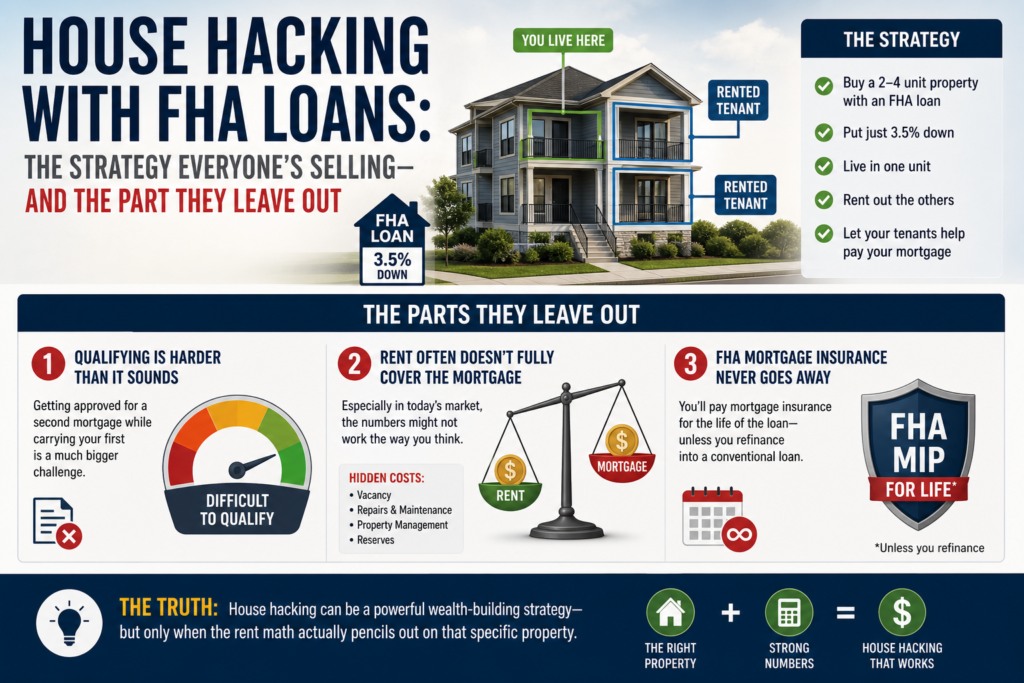
House Hacking FHA Loan: What the YouTube Gurus Don’t Tell You
If you’ve spent any time on real estate YouTube, you already know the pitch.
“Use a house hacking FHA loan to buy a duplex with 3.5% down, live in one unit, rent out the other, and let your tenants pay your mortgage. Rinse and repeat every year until you’re rich.”
Sounds clean. Sounds almost too easy. And honestly — parts of it are real. A house hacking FHA loan is a legitimate strategy that has worked for a lot of people. But there’s a version of this story that doesn’t make it into the thumbnails. The part where the rent doesn’t cover the mortgage. The part where round two falls apart at the lender’s desk. The part where what looked like a wealth-building shortcut starts to feel more like a slow financial trap.
I’ve been studying this strategy pretty hard, and here’s the full picture.
What a House Hacking FHA Loan Actually Is
FHA loans are government-backed mortgages built to make homeownership more accessible. The main draw is the down payment — 3.5% down with a credit score of 580 or higher. On a $300,000 property, that’s $10,500 instead of $60,000.
The catch: you have to actually live there. FHA loans aren’t for straight-up investment properties — they require owner occupancy.
House hacking uses that rule on purpose. You buy a 2–4 unit property using a house hacking FHA loan, move into one unit, and rent out the rest. You’re living there, so you qualify. Your tenants’ rent helps offset the mortgage.
After a year of occupancy, you’ve met the requirement. You can move out, rent your old unit too, and technically start the process over with a new FHA loan on your next property.
On paper, it’s elegant. In practice, it’s messier.
Where a House Hacking FHA Loan Gets Complicated
Problem 1: Qualifying for the second property
This is where most YouTube videos go quiet.
When you go to buy property number two, you still carry the mortgage from property number one. Lenders want to know you can handle both.
Rental income can help — but not fully. Most lenders will only count 75% of your rental income toward your qualifying figures, to account for vacancy and expenses. And if you don’t have documented rental history (signed leases, tax returns with Schedule E), some lenders won’t count it at all.
So you either need enough personal income to cover both mortgages, or you need to prove your rental income makes up the gap. For self-employed investors or anyone with complicated income on paper, this is often where the strategy stalls.
Problem 2: The rent might not cover the mortgage
The entire pitch rests on this assumption: that your tenants’ rent will cover your payment.
Sometimes it does. In markets with strong rental demand and lower purchase prices, the math can work beautifully. But in a lot of markets right now — including parts of Philadelphia — prices have risen faster than rents. Your mortgage on a newly purchased duplex might be $2,200/month. The unit next door rents for $1,100.
That’s helpful. That’s not “tenants pay your mortgage.” And once you add maintenance, vacancy months, and property taxes, the monthly drain adds up fast.
Problem 3: FHA has limits on how many times you can use it
You can only hold one FHA loan at a time. Getting a second FHA loan while the first is still active requires you to prove a legitimate reason for moving — job relocation, family size change, something documented and defensible. Lenders look closely at this.
The “do it every year forever” version of the strategy is harder to pull off than the content makes it sound.
Problem 4: Mortgage insurance doesn’t go away
A house hacking FHA loan comes with mortgage insurance premium (MIP) for the life of the loan — unless you put 10% down or refinance into a conventional loan later. That’s typically 0.55%–0.85% of the loan amount annually, tacked onto your monthly payment indefinitely.
On a $300,000 loan, that’s $1,650–$2,550 per year. It’s not a dealbreaker, but it’s a real cost that quietly eats into your cash flow. It almost never makes it into the “3.5% down millionaire” content.
When a House Hacking FHA Loan Actually Works
None of this means it’s a bad strategy. It means it works best under specific conditions — and realistic expectations make all the difference.
It tends to work when:
The rent covers most or all of the mortgage. Run the real numbers using current rental data for your specific market before you buy — not optimistic projections from someone selling a course.
You have stable, documentable income that can support qualifying for a second mortgage down the road.
You’re buying in a market where rents are strong relative to purchase prices. Philadelphia still has pockets where this pencils out — smaller multi-units in neighborhoods with solid rental demand are worth looking at seriously.
You actually want to live there for at least a year. This sounds obvious, but a lot of people underestimate what it’s like to be a landlord and a tenant in the same building at the same time.
The Honest Take
A house hacking FHA loan is one of the few real tools available to investors who don’t have a lot of cash sitting around. It’s legitimate. It has worked. But it’s not the passive, automatic wealth machine that fills up your recommended feed.
The people who make it work treat it like a business from day one. They run real numbers on specific properties. They talk to a lender before they make an offer — not after — to understand exactly what round two looks like. They budget for vacancy, repairs, and the months when something breaks at the worst possible time.
The people who struggle are usually the ones who bought the idea before they understood the math.
Real estate builds wealth. Just not as fast or as cleanly as a YouTube thumbnail suggests.
According to the National Association of Realtors, first-time buyers consistently cite down payment and qualifying requirements as the top barriers to homeownership — which is exactly why the FHA route gets so much attention.
Want to see if the numbers actually work on a specific property? Run the numbers through the Multi-Unit Cash Flow Calculator before you make any moves.
Not financial advice — just someone doing a lot of research and asking a lot of questions.