How to Flip a House Step by Step: Selling, Renting, and BRRRR (Part 3)
You made it to Part 3. The renovation is done, the GC has been paid, and you’re standing in a house that actually looks good now. This is where flip house selling tips stop being theory and start being real decisions with real money on the line.
Step 10: The Renovation Is Done — Final Walkthrough First
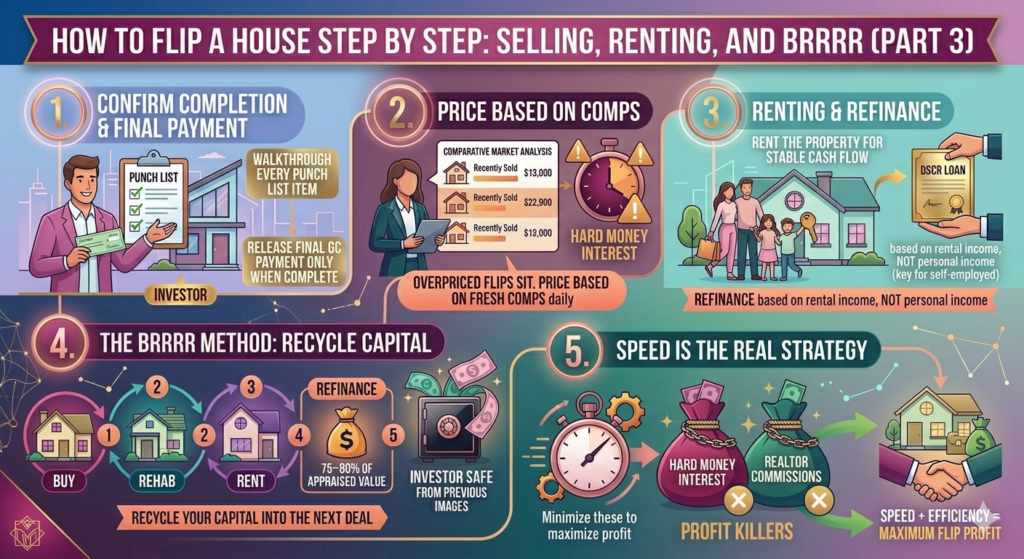
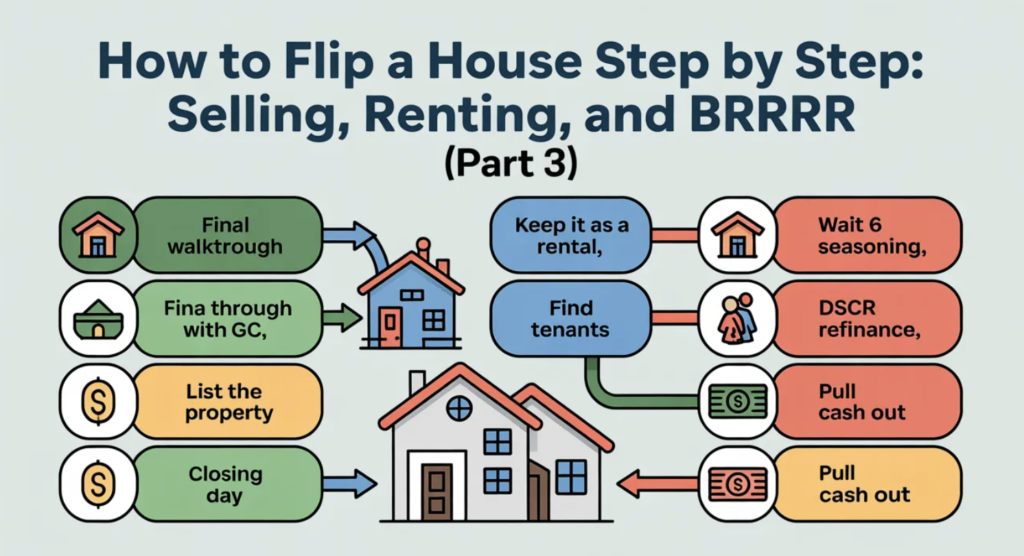
Before you do anything else, do a final walkthrough with your GC and go through the punch list. Every single item needs to be complete before you release that final payment. Check:
- All fixtures working (lights, faucets, toilets, appliances)
- Paint clean and consistent throughout
- Floors finished with no gaps or damage
- Doors and windows opening and closing properly
- Exterior and curb appeal — first impressions matter enormously when you’re selling
Once you’re satisfied, release the final draw to your GC. Then call your realtor.
Step 11: Flip House Selling Tips — Pricing, Staging, and Timeline
The best flip house selling tips start with one thing: don’t get emotional about the listing price.
Your realtor will pull fresh comps and recommend a number. The market decides what the property is worth, not what you need to make. Price it right from the start. Overpriced properties sit, and every extra week costs you hard money interest.
Do you use the same realtor?
You can — but you don’t have to. The buyer’s agent who helped you purchase is great at finding deals. Selling is a different skill set. You want a listing agent who knows how to market properties, stage them correctly, and negotiate offers. Ask to see their recent sales, how long properties sat, and whether they sold close to asking.
Staging:
An empty house is harder to sell than a furnished one. At minimum, consider virtual staging or renting key pieces — a couch, a dining table, a bed frame. It helps buyers visualize the space and consistently leads to faster sales and higher offers.
The selling timeline:
List → showings → offers → negotiate → inspection → buyer financing → escrow → closing. From listing to closing typically takes 30–60 days in a normal market. Escrow pays off your hard money loan, closing costs come out, and the rest goes to you.
Run your final profit number before you list with the Philly Flip Profit Calculator — so you know exactly what you’re walking away with after commissions, interest, and closing costs.
Step 12: What If You Want to Rent It Instead?
Maybe the market feels soft. Maybe the rental cash flow looks better than the flip profit right now. Either way, you’ve decided to keep it.
Finding tenants yourself:
- List on Zillow, Apartments.com, Facebook Marketplace
- Screen applicants — credit check, income verification (ideally 3x monthly rent), rental history
- Draft a lease using a standard Pennsylvania template or have a real estate attorney review it
- Collect first month, last month, and security deposit at signing
This saves money but costs time. For one property, it’s doable if you’re local.
Hiring a property management company:
A property manager handles everything: advertising, screening, rent collection, maintenance, late payments, and evictions. Their fee is typically 8–12% of monthly rent. In Philadelphia specifically, tenant protections are strong — evictions follow strict legal process. Having a property manager who knows the local rules is genuinely valuable.
Use the Rental Property Analyzer to see whether the rent covers your new mortgage before you commit to holding the property.
Step 13: BRRRR — When Do You Actually Refinance?
If your plan was BRRRR all along, the refinance is how you get your capital back out to do it again.
Seasoning period:
Most conventional lenders require you to own the property for at least 6 months before refinancing based on the new appraised value. Some require 12 months. DSCR lenders are often more flexible.
Timeline typically looks like: Close → renovate (2–3 months) → place a tenant → wait out seasoning → refinance.
DSCR vs. conventional refinance:
A conventional refinance looks at your personal income, debt-to-income ratio, and tax returns. If your income on paper is low — common for self-employed investors — this can be a challenge.
A DSCR loan doesn’t look at your personal income at all. It looks at whether rental income covers the mortgage payment. If rent is $1,500/month and your new mortgage is $1,100/month, your DSCR is 1.36 — most lenders want 1.25 or higher. You qualify based on the property’s income, not yours.
How much can you pull out?
Most lenders refinance up to 75–80% of appraised value on investment properties. If your property appraises at $280k, you can pull out up to $224k. If your total project cost was $190k, you get that back — plus a little extra — and your new payment is covered by rent. That’s the BRRRR cycle.
Step 14: What Did You Actually Make?
Let’s put it together with a real example:
- Purchase price: $140,000
- Renovation cost: $55,000
- Hard money interest + points (6 months): $18,000
- Closing costs (buy + sell): $10,000
- Realtor commission (6% of $280k): $16,800
- Total costs: $239,800
- Sale price: $280,000
- Profit: $40,200
Notice how much hard money interest and commissions eat into that number. Every extra month of carrying costs you $2,000–$3,000. Get in, renovate fast, sell fast — those are the real flip house selling tips that matter.
On taxes: if you sell within a year, profit is taxed as ordinary income. Hold longer than a year and you get long-term capital gains rates. Most flips happen within a year — budget for the higher rate and talk to a CPA before your first deal. According to the IRS, short-term capital gains on investment property are taxed at your ordinary income rate, which can be significantly higher than the 15–20% long-term rate.
The Whole Picture
Three parts, one complete process. From running numbers on Zillow to a wire transfer at closing — now you know how it actually works.
Philadelphia is full of opportunity right now. The numbers work here in a way they don’t in most major cities. And knowing the process start to finish — including the real flip house selling tips that move properties fast — puts you miles ahead of most people who say they want to flip houses but never actually start.
Now you have no excuse.
Not financial advice — just someone doing a lot of research and asking a lot of questions.