How to Flip a House Step by Step: Hiring a GC and Managing the Renovation (Part 2)
So you closed. The property is yours, the hard money clock is ticking, and now you’re standing in a house that needs a lot of work.
This is Part 2 of the flip a house step by step series — and this is where most first-time flippers freeze up. Not because the work is impossible, but because nobody explained who does what.
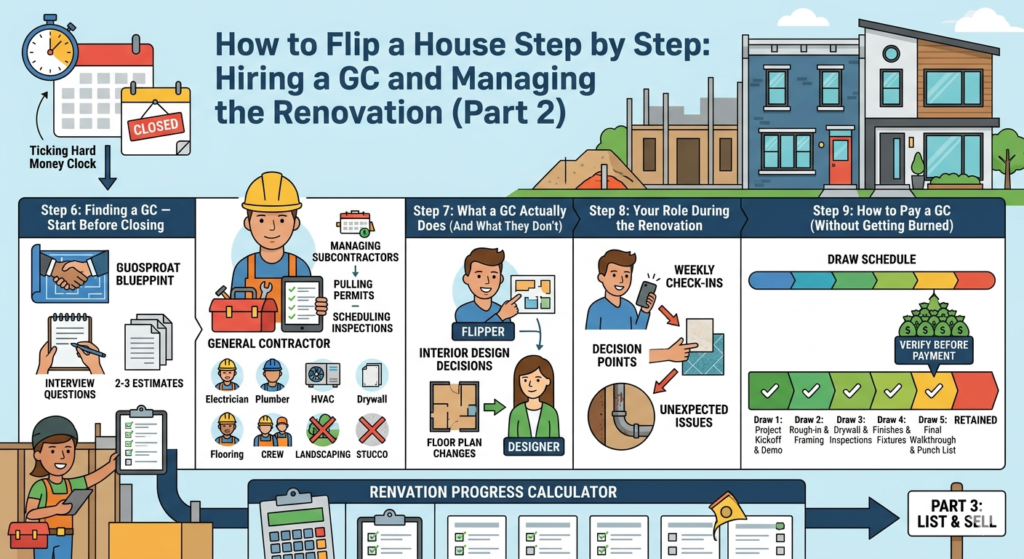
Step 6: Finding a GC — Start Before You Close
Here’s something nobody tells you when you’re learning to flip a house step by step: start looking for a General Contractor before you close on the property.
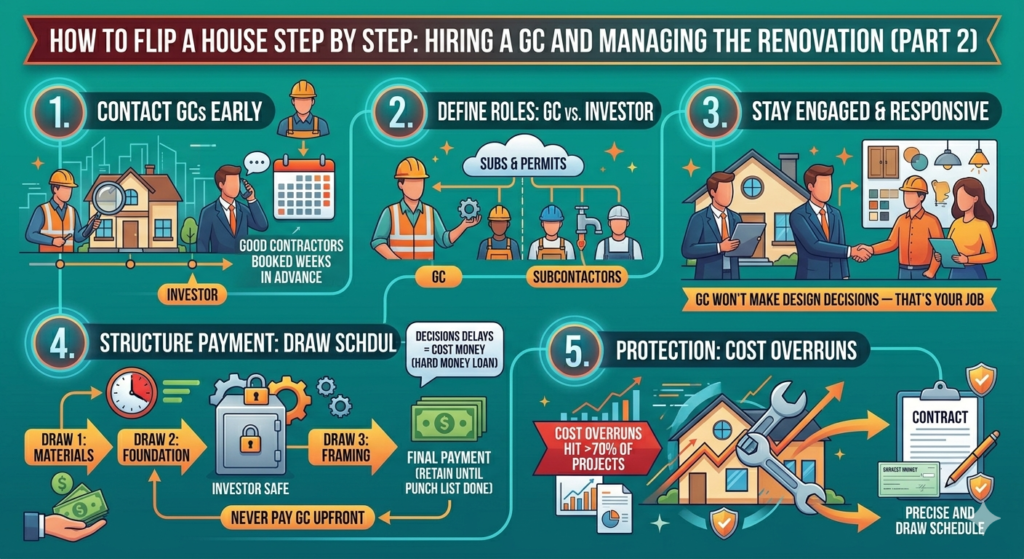
Why? Because good GCs are busy. The ones worth hiring are booked out weeks in advance. If you wait until you own the property to start making calls, you’re losing money every day your hard money loan sits idle with no work happening.
Ideally you’re reaching out to GCs during your inspection period — before you’re even fully committed to the deal. Walk the property with a GC, get a rough estimate, and confirm your renovation budget is realistic before you’re locked in.
Where to find GCs:
- Referrals from other investors (best option by far)
- Local real estate investor meetups and Facebook groups
- Houzz, Angi, or Thumbtack (okay for leads, but verify everything)
- Your hard money lender — they’ve seen a lot of projects and often know good contractors
When you interview a GC, ask:
- How many projects are you currently running?
- Can I see photos of recent completed projects?
- Do you pull your own permits?
- How do you handle subcontractors — do you have your own crew or do you hire out?
- What does your payment schedule look like?
- Can you provide references from recent clients?
Get at least 2–3 estimates before you decide. Not just for price comparison — talking to multiple GCs teaches you a lot about what the scope of work actually involves.
Step 7: What a GC Actually Does (And What They Don’t)
A General Contractor is essentially a project manager with a license and a network. They don’t necessarily do the physical work themselves — they coordinate everyone who does.
What a GC typically covers:
- Hiring and managing subcontractors (electricians, plumbers, HVAC, drywall, flooring)
- Pulling permits for work that requires them
- Scheduling inspections at the right stages
- Managing timeline and sequencing of work
- Structural work, framing changes, roof, windows, doors
- Kitchen and bathroom renovations
- Flooring, painting, finishing work
What you need to ask about specifically:
Landscaping and curb appeal — some GCs include this, many don’t. Lawn, bushes, exterior cleanup often goes to a separate crew. Ask upfront.
Interior design decisions — this is on you. A GC will build what you tell them to build. They’re not going to pick your tile, your cabinet color, your light fixtures. That’s your job. Your realtor can actually help here — ask them what finishes buyers in that price range expect.
Floor plan changes — if you want to move walls, open up a layout, add a bathroom, discuss this with your GC before work starts. Get any scope changes in writing.
Use the Flip Checklist Calculator to map out your full renovation scope before your first GC meeting — it forces you to think through every line item before someone else does it for you.
Step 8: Your Role During the Renovation
You don’t need to be on-site every day. That’s part of what you’re paying a GC for.
But “not every day” doesn’t mean “never.” Here’s what your actual involvement looks like:
Weekly check-ins — either in person or via photos/video. A good GC will send you regular updates. If they go silent for a week, that’s a red flag.
Decision points — there will be moments where you need to choose: this tile or that one, this cabinet hardware or that one, do we keep this wall or open it up. These decisions can’t wait — delays cost you money on a hard money loan. Be responsive.
Unexpected issues — and there will be unexpected issues. Open up a wall in a 1940s Philadelphia rowhouse and you might find knob-and-tube wiring, old pipes, or something nobody expected. Your GC will call you, explain the problem, and give you options. You decide.
Don’t micromanage — if you hired a good GC, trust them. Showing up every day to second-guess decisions destroys the working relationship and slows everything down.
A good rhythm: visit once or twice a week, have a standing check-in call, and be reachable by text for quick decisions.
Step 9: How to Pay a GC (Without Getting Burned)
Never pay a GC in full upfront. Ever. A legitimate contractor will not ask you to.
The standard structure is a draw schedule — you pay in installments tied to completed milestones, not to time passing.
A typical draw schedule:
- Draw 1 (10–15%): Project kickoff, materials ordered, demo complete
- Draw 2 (25%): Rough framing, electrical rough-in, plumbing rough-in complete
- Draw 3 (25%): Drywall, HVAC, inspections passed
- Draw 4 (25%): Flooring, cabinets, fixtures installed
- Draw 5 (10–15%): Final walkthrough complete, punch list done, everything finished
Verify each milestone before releasing the next payment. Walk the property, confirm the work is done, then pay.
If your hard money lender manages draws — some do, especially for larger projects — they’ll send their own inspector to verify work before releasing funds. This protects you and keeps everyone accountable.
Retain the final payment until everything on the punch list is complete. Contractors are much more motivated to knock out that list when there’s still money on the table.
Get everything in writing. Scope of work, timeline, payment schedule, what happens if costs go over budget. A handshake deal with a contractor is a great way to lose money.
According to the National Association of Home Builders, cost overruns affect more than 70% of renovation projects — which is exactly why draw schedules tied to milestones exist.
What’s Next
That’s Steps 6–9 of the flip a house step by step process — from finding a GC to managing the renovation without losing your mind or your margin.
Part 3 covers the finish line: listing and selling the property, what to do if you want to rent it instead, how to find tenants or hand it off to a property manager, and if you’re going the BRRRR route — exactly when and how to refinance to pull your cash back out.
The renovation is the hard part. Getting paid is the fun part.
Not financial advice — just someone doing a lot of research and asking a lot of questions.