I came across a video recently that kind of broke my brain a little — in the best way.
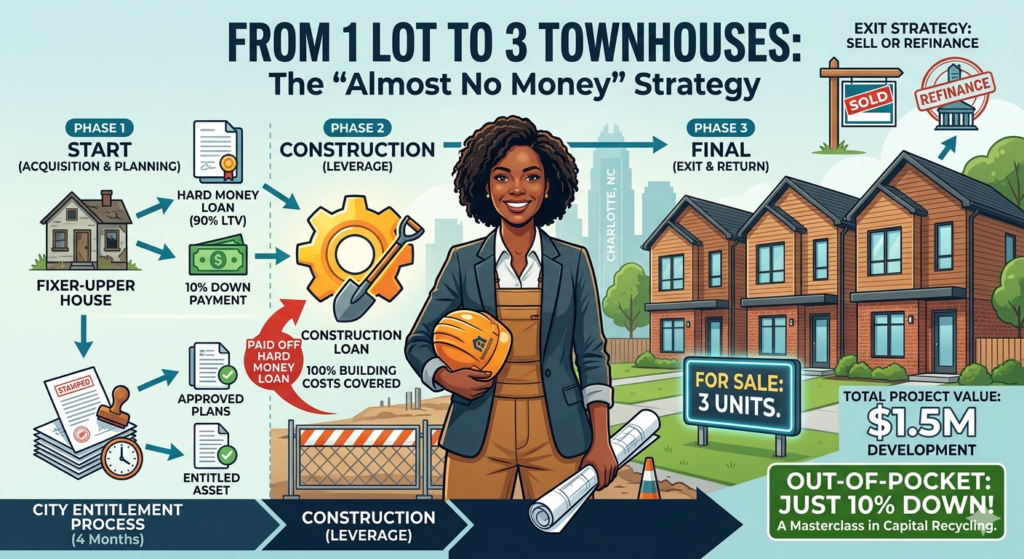
A woman in Charlotte, NC built three townhouses — a $1.5 million development — and the only money she put in out of pocket was a 10% down payment on the original land purchase. That’s it. No massive bank account. No rich uncle. Just a really smart sequencing of financing.
Here’s exactly how she did it, and why I think this strategy is worth understanding if you’re anywhere near the Philadelphia market.
She Started with a Flip — Then Changed Her Mind
The original plan was simple: buy a distressed property in Charlotte, fix it up, sell it, make around $40K. Totally normal flip strategy.
To buy the property, she used a hard money lender — which covered 90% of the purchase price. So she only needed 10% of her own money to get in the door.
But once she owned it, she started looking at the land differently. The lot had more potential than a single flip. Instead of just renovating the existing structure, she decided to tear it down and build three townhouses.
That pivot changed everything.
The Entitlement Process: The Part Nobody Talks About
Before she could break ground, she had to get the city of Charlotte to approve her development plans. This is called the entitlement process — zoning approvals, architectural plans, permits.
It took about four months.
This is the part that most beginner investors skip over when they imagine “becoming a developer.” It’s not just building stuff — there’s a whole bureaucratic process before a single nail goes in. In Philadelphia, this process exists too, and it can take longer depending on the neighborhood and what you’re trying to do.
But here’s the thing — once she had those approvals in hand, she had something valuable. An entitled piece of land with approved plans is worth significantly more than raw land. That’s leverage.
The Construction Loan: Where the Magic Happened
With city approval secured, she went to a construction lender.
Construction loans work differently from regular mortgages. They’re designed to fund the building process — lenders release funds in stages (called draws) as construction milestones are hit, not all at once upfront.
Here’s the key part of her strategy: the construction loan covered 100% of the building costs. And with that loan, she also paid off the original hard money loan she used to buy the property.
So at this point:
- Hard money loan: paid off ✅
- Construction fully funded ✅
- Her own cash still in the deal: just that original 10% down payment
She essentially recycled her capital through the deal structure.
Breaking Down the Strategy
| Step | What She Did | Financing Used |
|---|---|---|
| Buy the property | Purchased distressed lot | Hard money loan (90% LTV) |
| Pivot the plan | Decided to develop instead of flip | No new money needed |
| Get approved | Went through entitlement process | Time, not money |
| Secure construction loan | Got 100% construction financing | Construction lender |
| Pay off hard money | Used construction loan proceeds | Recycled capital |
| Build 3 townhouses | Full development | Construction loan draws |
Total out of pocket: ~10% of the original purchase price on a $1.5M project.
Could This Work in Philadelphia?
Honestly? Yes — and Philadelphia might actually be a better market for this than Charlotte right now.
Here’s why I think about this a lot: Philly has tons of underutilized lots, aging rowhouses on large footprints, and neighborhoods where new construction is starting to pencil out. Germantown, Brewerytown, parts of North Philly — there are parcels sitting there that aren’t being used to their full potential.
The entitlement process in Philadelphia runs through the Department of Licenses and Inspections (L&I), and yes, it can be slow. Zoning variances, civic design reviews, neighborhood meetings — it adds time. But that time is also a barrier to entry that keeps competition lower than in markets like Austin or Charlotte.
The financing stack she used — hard money to acquire, construction loan to build — is available in Philadelphia. Hard money lenders operate actively here. Construction lenders exist. The question is whether the numbers work on a specific deal.
That’s where the math has to be done carefully before you commit.
What I’m Taking Away from This
I’ve been focused on fix-and-flip as the entry point into real estate — and that’s still valid. But this strategy made me think differently about what “the exit” can look like.
You don’t have to flip. Sometimes the land is worth more as a development play. The key is recognizing that moment — like she did — when you’re already in a deal and the opportunity is bigger than what you originally planned for.
It requires more patience (four months of entitlement alone), more coordination with lenders, and more risk tolerance. But the upside is a completely different scale.
I’m not saying I’m doing this tomorrow. I’m saying I’m paying attention.
Not financial advice — just someone doing a lot of research and asking a lot of questions.