I’m going to be upfront with you: when I first saw this strategy, my immediate reaction was “okay but that can’t actually work.”
Then I ran the numbers. And it does.
Here’s the story — and more importantly, here’s exactly how the math works.
The Setup
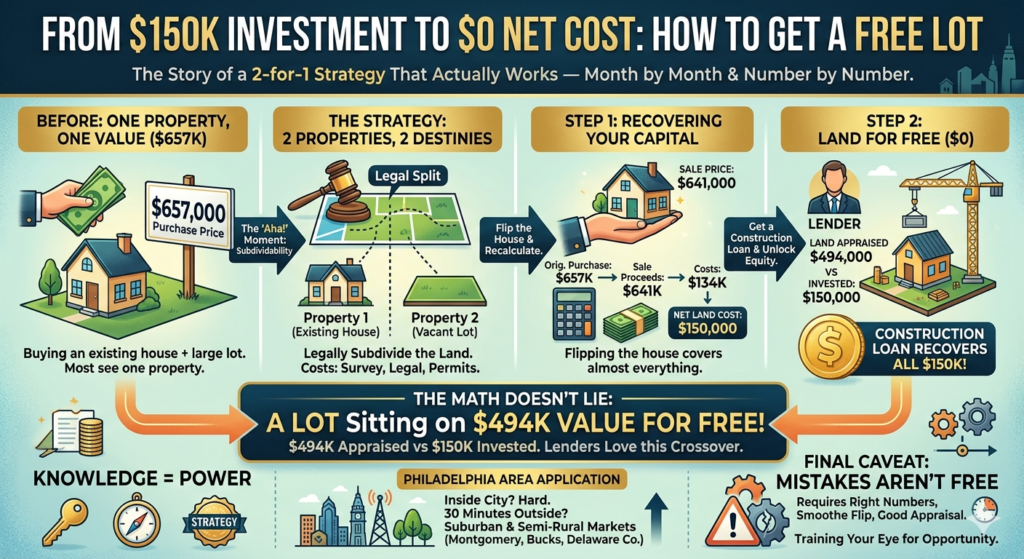
An investor found a property that included an existing house plus a large lot — enough land to eventually split into two separate parcels. He paid $657,000 for the whole thing.
Most people would look at that and think: one property, one house, done.
He saw something different. He saw two properties.
Step 1: Buy the Property
Purchase price: $657,000. The key wasn’t just the house — it was the extra land sitting next to it. Land that could be legally separated and built on.
This is the part most buyers miss. When you’re looking at properties, especially in suburban or semi-rural areas, always ask: is this lot subdividable? It’s a question that can completely change the math on a deal.
Step 2: Subdivide the Land
He worked with a surveyor and an attorney to legally split the property into two separate parcels:
- Property 1: The existing house
- Property 2: The vacant lot
This process costs money — surveys, legal fees, permits — but it’s a one-time cost that unlocks enormous value.
Step 3: Flip the Existing House
Property 1 — the house — got renovated and sold for $641,000.
Now here’s where the math gets interesting. After the sale price and transaction costs, he calculated his net cost for the vacant land:
- Original purchase: $657,000
- Sale proceeds: $641,000
- Transaction costs: $134,000
- Net cost of the vacant lot: $150,000
So after flipping the house, he effectively paid $150,000 for a piece of land. That’s it. The house sale covered almost everything.
Step 4: Get the Construction Loan — and Get Your Money Back
Here’s where it gets really good.
He applied for a construction loan to build a new house on the vacant lot. The lender ordered an appraisal of the land.
Appraised value: $494,000.
The lender looked at that number — $494K appraised value vs. $150K invested — and issued a loan that covered his entire $150,000 investment and then some.
Net cost of the land after the construction loan: $0.
He got his money back. All of it. And he still owns the land — with a brand new house going up on it.
“Mistakes Aren’t Free”
To his credit, he added one important caveat at the end: “mistakes aren’t.”
This strategy works when the numbers are right, the subdivision is legal and feasible, the flip goes smoothly, and the appraisal comes in where you need it. A lot of moving parts have to align.
It’s not a beginner strategy. But understanding how it works changes the way you look at properties forever.
Can You Do This in Philadelphia?
Inside the city? Hard. Philadelphia lots are small and tight — subdivision is complicated and the math usually doesn’t work.
But 30 minutes outside the city? Different story.
Montgomery County, Bucks County, Delaware County — there are properties out there with houses sitting on larger lots that haven’t been looked at this way. The suburbs around Philadelphia are still underpriced relative to what’s coming. And subdivision opportunities exist if you know what to look for.
The key is training your eye to see two properties when everyone else sees one.
I’m not there yet — this strategy requires capital and experience I’m still building toward. But I’m filing it away. Because the day I have the right deal in front of me, I want to know exactly what to do with it.
Run Your New Construction Numbers: