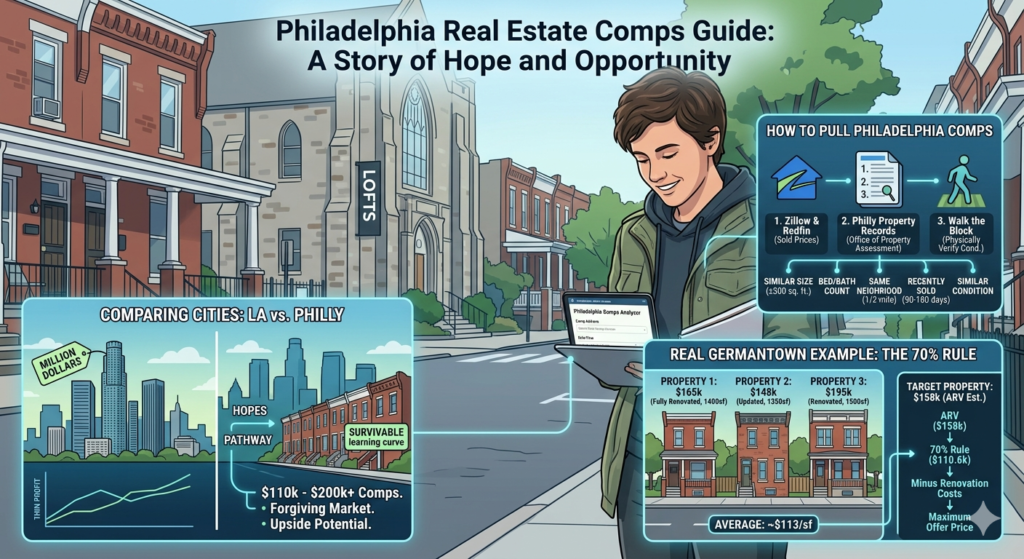
When I was flipping houses in Los Angeles, the baseline was a million dollars.
Not a nice house. Not a renovated house. Just a house. A basic, nothing-special house in a nothing-special neighborhood — a million dollars. Sometimes more.
The math was brutal. The margins were thin. One mistake and your profit disappeared. I always felt like I was playing a game where the stakes were too high and the room for error was too small.
Then I came to Philadelphia and started walking neighborhoods.
In Germantown, I found houses selling for $110,000. Not abandoned shells — actual houses, with bones, with potential. Around them, renovated comps going for $150,000, $180,000, sometimes $200,000. Churches being converted into loft apartments. Old factories becoming lofts. Buildings that look like nothing from the outside becoming something remarkable once someone with vision gets hold of them.
I am currently broke for business scam. I will say that directly. But Philadelphia is giving me hope in a way Los Angeles never did — because here, I can still see a path. The numbers still make sense for someone starting over.
That’s what comps showed me.
What Comps Actually Are
Comps — short for comparable sales — are the recent sale prices of properties similar to the one you’re analyzing.
They answer one question: what is this property actually worth in today’s market?
Not what the seller is asking. Not what Zillow’s algorithm estimates. What similar properties in the same neighborhood have actually sold for, recently, to real buyers.
This is the foundation of every serious real estate calculation. Your ARV — After Repair Value — is only as accurate as your comps. Get the comps wrong and every number downstream is wrong too.
How to Pull Comps in Philadelphia
The tools are free. What matters is how you use them.
Zillow and Redfin are your starting points. Both show recent sold prices — not just active listings. Filter for sold properties and you’ll see what buyers actually paid.
Philadelphia’s property records are publicly available through the Office of Property Assessment. You can look up any address and see the sale history, assessed value, and square footage.
Walking the neighborhood is something no algorithm can replace. I do this every day in Germantown. I look at what’s been renovated, what’s still distressed, what’s under construction. The physical reality of a block tells you things Zillow can’t.
The Criteria That Matter
Not every sold property is a useful comp. You want properties that are:
Similar in size — within 200 to 300 square feet of your target property. A 1,200 square foot house and a 2,000 square foot house are not comparable even if they’re on the same block.
Similar in bedroom and bathroom count — a three-bedroom two-bath and a two-bedroom one-bath serve different buyers at different price points.
In the same neighborhood — ideally within a half mile. Philadelphia neighborhoods can change dramatically within a few blocks. A comp from the wrong block can mislead you significantly.
Sold within the last 90 to 180 days — real estate markets move. A sale from two years ago tells you where the market was, not where it is.
In similar condition — a fully renovated comp and a distressed property are not the same thing. When you’re evaluating a flip, you want comps of renovated properties — that’s your ARV target.
A Real Germantown Example
I walked a block in Germantown recently and looked at three properties that had sold in the past six months.
Property 1: 1,400 square feet, 3 bed 1 bath, fully renovated — sold for $165,000 Property 2: 1,350 square feet, 3 bed 1 bath, updated kitchen and bath — sold for $148,000 Property 3: 1,500 square feet, 3 bed 2 bath, full renovation — sold for $195,000
Average price per square foot across these three: approximately $113 per square foot.
If I’m looking at a 1,400 square foot distressed property on the same block, my ARV estimate is approximately $158,000. From there I apply the 70% rule, subtract renovation costs, and arrive at my maximum offer price.
That’s how comps work in practice. Not complicated — but only useful if you’re pulling the right data.
What Philadelphia Taught Me That Los Angeles Couldn’t
In Los Angeles, the numbers were so large that small percentage errors meant enormous dollar losses. A 5% mistake on a million dollar property is $50,000.
In Philadelphia, the scale is different. A 5% mistake on a $150,000 property is $7,500 — still meaningful, but survivable. The market is more forgiving of the learning curve.
And the upside is real. I live in a building that used to be something else entirely — an old structure that someone converted into something modern and livable. All around me in Germantown, I see the same thing happening. Churches, factories, warehouses — being transformed.
I want to be part of that. I’m not there yet. But the comps tell me the opportunity is real.
Run Your Own Comps
I built a free Comps Analyzer below. Enter up to five recent comparable sales — the address or description, square footage, and sale price — and it will calculate the average price per square foot, estimate your ARV, and tell you your maximum offer price based on the 70% rule.
Use it on the next property you walk. The numbers don’t lie.