I didn’t plan on ending up in Germantown.
I’d been bouncing around — LA, New York, New Jersey, DC — and when I landed in Philadelphia, I was doing what every semi-desperate apartment hunter does: scrolling Zillow at midnight, filtering by price, trying to convince myself that “character” is a feature, not a warning sign.
The apartment looked amazing online. A converted school building. High ceilings, exposed brick, the whole thing. Historic. Charming. I signed the lease feeling pretty good about myself.
Then I moved in during a blizzard.
The First Chapter: What a Converted School Building Actually Sounds Like
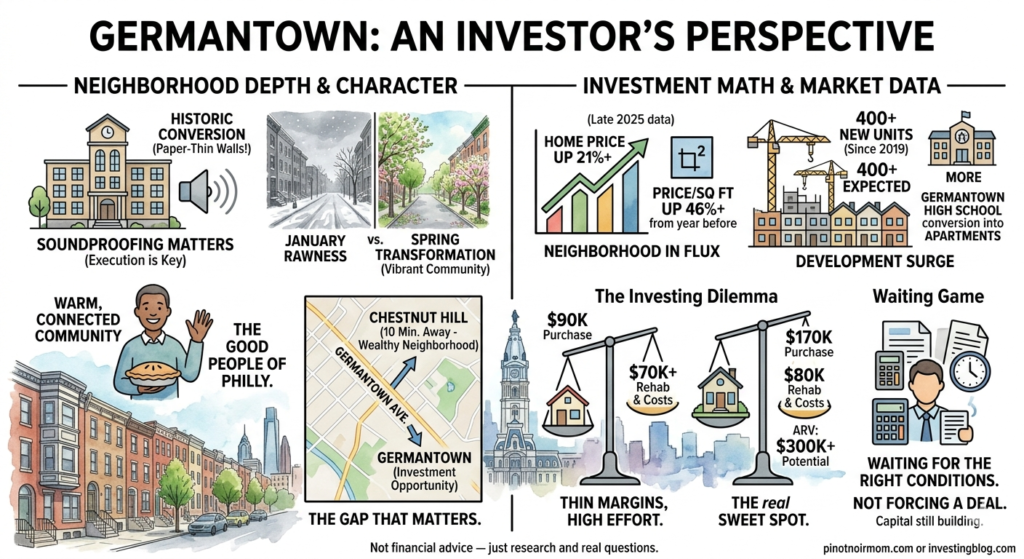
Here’s what nobody puts in the listing: old school buildings were not designed with soundproofing in mind. They were designed to project a teacher’s voice across a room of thirty kids. That engineering philosophy, it turns out, carries over beautifully into apartment living.
I can hear my upstairs neighbor’s every footstep. The neighbor to my left — their TV, their phone calls, their life. The construction was rushed, the walls are paper-thin, and let’s just say everyone in the building has very different taste in music volume.
I say this not to complain (okay, a little to complain) but because this is exactly the kind of thing you need to know if you’re thinking about buying and renovating property in Philadelphia. Conversion projects look incredible on paper. The bones are beautiful. But the execution matters enormously — and cheap rehab work will follow a building for decades.
File that away. We’ll come back to it.
January in Germantown: Honest First Impressions
I arrived in the dead of winter. Snow everywhere, the kind that turns gray within hours in a city. The streets felt raw. Unfamiliar. I’m an immigrant — I moved to the US from Korea back in 2012 — and I’ve lived in enough new places to know that feeling: that first-week disorientation where everything feels slightly off and you wonder if you made a mistake.
Germantown in January is not trying to impress you. The storefronts along the avenue are a mix of everything — hair salons, corner stores, churches, the occasional boarded-up window. It’s not curated. It doesn’t perform for newcomers.
I kept to myself mostly. Ordered in. Wondered what I’d gotten into.
Then Spring Happened
I don’t know exactly when it shifted, but somewhere around March the whole neighborhood transformed.
Trees I hadn’t noticed suddenly had leaves. The courtyard in front of my building — which had looked like a gray slab — filled in with actual grass, flower beds, little bursts of color I didn’t know were coming. People started sitting outside. The avenue got louder in a good way.
And then I started actually talking to my neighbors.
I have lived in a lot of places. A lot of apartments, a lot of cities. I have never — and I mean never — had neighbors like this. My upstairs neighbor knocked on my door to introduce herself within the first week. People in the hallway actually stop and ask how you’re doing, and they mean it.
I went to the grocery store one day and the cashier helped me figure out my rewards card, called me “hon,” and sent me off like she’d known me for years. I needed to put some boxes in storage nearby — the guy working there spent twenty minutes helping me figure out the best unit size, carried a box to my car, and waved me off like I was family.
I’m not exaggerating when I say: I fell a little bit in love with Philadelphia people. There’s a warmth here that you don’t find in New York, that’s for sure.
The Ten-Minute Gap That Changed How I See This Neighborhood
Here’s the thing about Germantown Avenue that I think about constantly now, as someone who’s been seriously looking at real estate investment:
Drive ten minutes north on the same road. Same avenue. And you’re in Chestnut Hill.
If you don’t know Chestnut Hill — it’s one of the wealthiest neighborhoods in Philadelphia. Beautiful Victorian homes, boutique shops, the kind of streets where people walk their dogs very slowly because there’s no reason to rush. I drove through it one afternoon and noticed that even the older residents were impeccably dressed. Coordinated outfits, good shoes, the whole thing. This is serious money, ten minutes from my apartment.
Same street. Completely different world.
That gap is everything, from an investment standpoint.
What the Data Actually Says About Germantown Right Now
I’ve been doing a lot of research on this (occupational hazard of running a real estate investing blog), and the numbers are genuinely interesting.
Germantown home prices were up over 21% in late 2025 compared to the year before. Price per square foot jumped 46%. Developers have been pouring in — over 400 new housing units came online since 2019, with another 400+ expected. They’re literally converting Germantown High School into a 240-unit apartment building.
The neighborhood is changing. Anyone who’s walked Germantown Avenue in the last two years can feel it.
The Honest Investing Problem I’m Sitting With
Here’s where I get real with you, because this blog isn’t about pretending everything is easy.
I’m actively looking at properties right now. And Germantown — or the neighborhoods nearby on that same arc toward Chestnut Hill — makes total sense on paper. I live here. I know which blocks are turning and which ones aren’t. I know where the new coffee shop opened and where the long-term residents are still holding it down. That local knowledge is genuinely valuable.
The problem is the math.
Properties under $100k exist in this market. But when you buy something that cheap, the renovation costs don’t scale down with the purchase price. You’re still looking at $60k, $70k, maybe more to get it right. And when you add hard money lending costs on top — origination points, monthly interest, the clock ticking while you’re mid-renovation — the margins get razor thin. You can do everything right and still walk away with $15k on a deal that consumed six months of your life.
The sweet spot in Philadelphia is higher — properties in the $150k-$200k acquisition range with ARV potential around $280k-$350k. Neighborhoods like Brewerytown, Port Richmond, the better blocks of West Philly. The math actually works there.
But getting to that entry point requires capital I’m still building toward. So for now, I’m watching, researching, running numbers, and being honest about where I am in the process.
That’s the real story of investing: most of it is waiting until the conditions are right, and not forcing a deal just because you’re impatient.
So — Is Germantown Worth Watching?
Yes. Genuinely, yes.
Not because it’s a sure thing. Real estate is never a sure thing, and anyone who tells you otherwise is selling something. But because the fundamentals are there: location between two established neighborhoods, development momentum, transit access, and a community of people who actually give a damn about where they live.
And honestly? Because the people are so good here that I find myself rooting for the neighborhood in a way I didn’t expect.
Even if I can hear everything through these walls.
Not financial advice — just someone doing a lot of research and asking a lot of questions.