Land survey house flipping knowledge is the part nobody talks about — and it almost blindsided me completely.
If you’ve been following my journey, you know I’ve been eating, sleeping, and breathing house flipping. I was focused on the “sexy” side: gut renovations, open-concept kitchens, profit calculations, creative financing.
I thought I knew the process. Find a run-down house, fix the inside, sell for a profit.
Then I started studying detailed blueprints for a gut-job and realized I didn’t actually know where my potential investment started and finished. That confusion led me straight into the dry, complex, but absolutely critical world of land survey house flipping professionals use on every single project.
If you’re building anything new, extending a structure, or working in a flood zone, a survey isn’t just a formality. It’s the roadmap for the entire project.
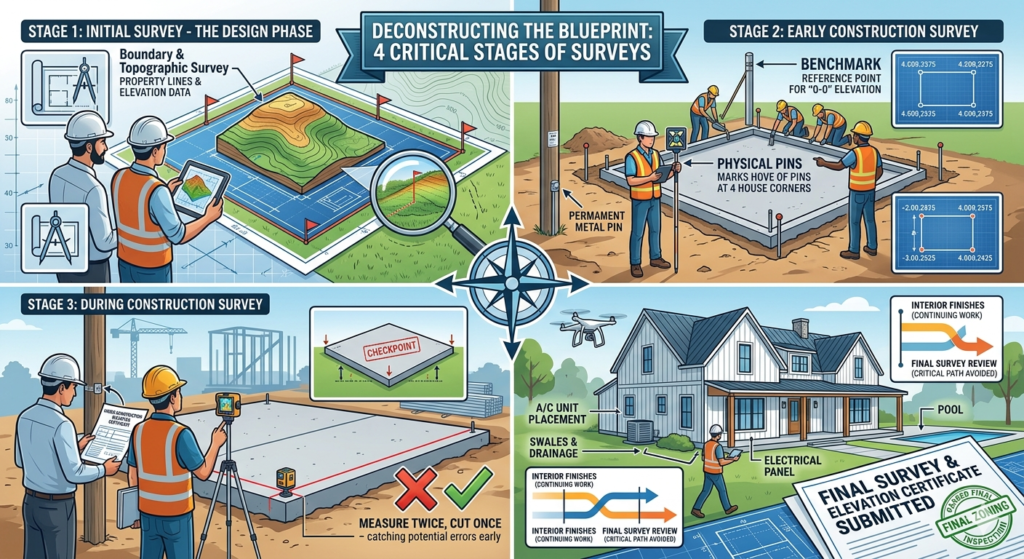
Land Survey House Flipping Stage 1: The Initial Survey (Design Phase)
“You can’t draw the map without knowing the territory.”
Boundary Survey — Confirms the exact property line. Establishes the legal limits of what you own. You must have this to avoid building your addition onto your neighbor’s driveway.
Topographic Survey — Maps the elevations across the entire property. Absolutely critical data for architects to create accurate blueprints. In some cities, you even need elevation data for adjacent buildings.
This data is the foundation that house designs and blueprints are built upon. No land survey house flipping project should skip this step.
Land Survey House Flipping Stage 2: Early Construction Survey
“Confirming the coordinates before digging.”
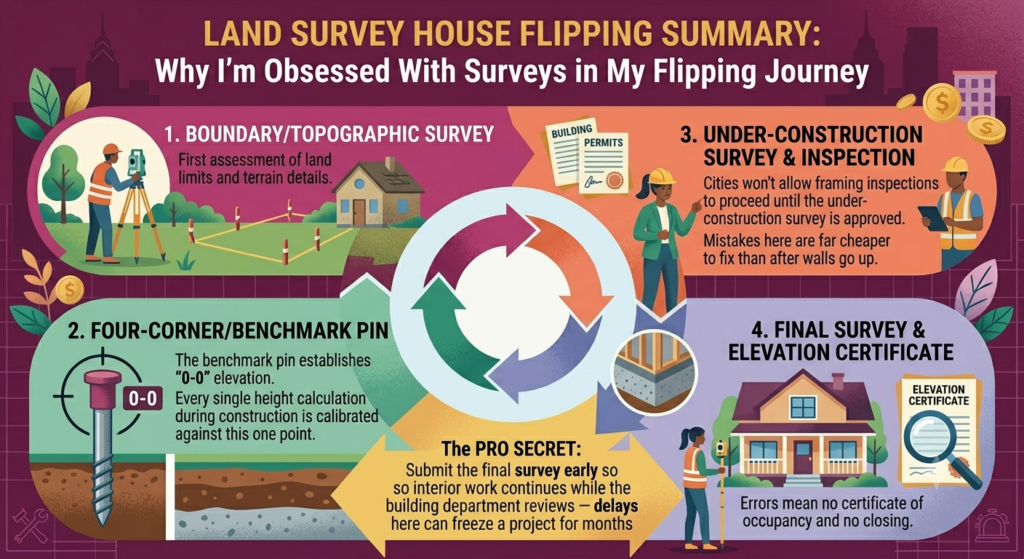
Four-Corner Survey — Surveyors place pins at the precise location of the building’s four main corners. This is the ultimate setback check — it dictates exactly where the foundation will be poured.
Benchmark — A stable reference point (often an immovable object like a utility pole or old tree) that establishes the “0-0” elevation for the finished floor. Every height calculation during construction must be calibrated against this single benchmark.
Land Survey House Flipping Stage 3: During Construction (After the Slab)
“The measure twice, cut once phase.”
Under-Construction Survey — Confirms the physical structure is still aligned with approved setbacks and zoning laws.
Under-Construction Elevation Certificate — Verifies the foundation was poured at the correct height relative to the benchmark.
Why this matters: in many jurisdictions, the city won’t allow the next inspection to proceed until this survey is approved. If there’s a mistake here, it’s infinitely easier and cheaper to fix before the walls go up.
Land Survey House Flipping Stage 4: The Final Survey
“The legal confirmation that you followed the rules.”
Final Survey and Final Elevation Certificate — Reviews every external element constructed. Mechanical equipment, electrical panels, pools, drainage systems, and swales must all match the original blueprints.
You must submit this survey and the Final Elevation Certificate to the building department before you can get your zoning inspection. Errors must be addressed or you will not pass the final inspection.
According to the National Society of Professional Surveyors, final elevation certificates are required in all FEMA flood zone areas before a certificate of occupancy can be issued.
The Million-Dollar Land Survey House Flipping Secret
In flipping, every day the house isn’t sold, you’re bleeding holding costs. Here’s what separates pro flippers from stressed-out beginners:
Make the final survey a non-critical path item.
The common mistake: waiting until all construction is 100% finished before calling the surveyor. This is a disaster waiting to happen.
The secret: have all external construction finished and the final survey submitted early. While the building department reviews it, your crew continues working on interior finishes.
If you submit the final survey at the very end, any delay in review could freeze the entire project — potentially delaying the Final Certificate of Occupancy and the closing by months.
Knowledge like this is what separates the investors who make money from the ones who bleed it.
Use the free Survey Timeline Tracker on this site to map out your survey stages before construction begins.
Not financial advice — just someone doing a lot of research and asking a lot of questions.