Multifamily real estate pros and cons are usually presented in one of two ways online — either “buy apartment buildings and get rich” or “being a landlord is a nightmare.” Most content picks a side and stays there.
So when I came across an investor who was honest enough to say both at the same time, I paid attention.
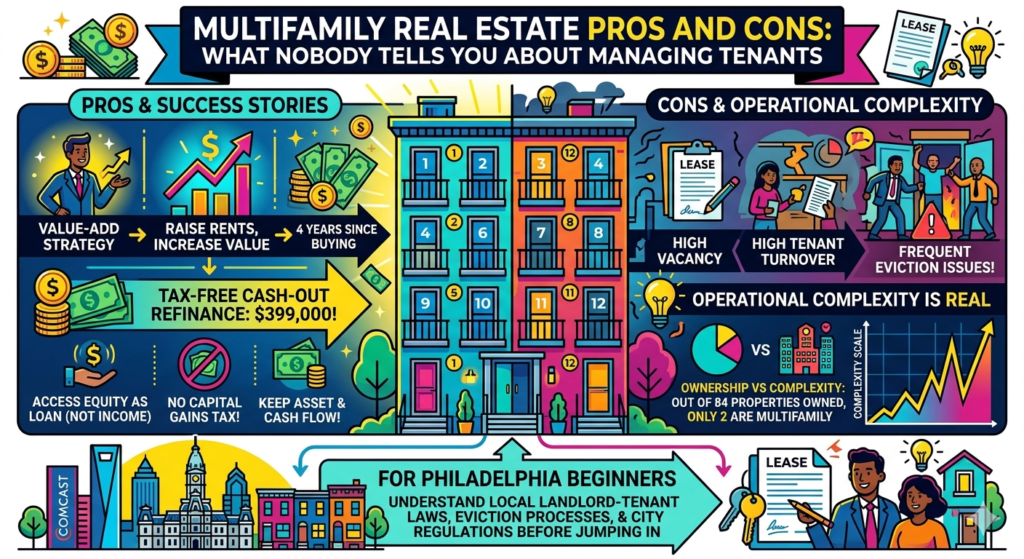
This guy owns 84 properties total. Only 2 of them are multifamily. And he has a lot of feelings about that.
The Win: $399,000 Cash-Out With Zero Tax
Four years ago he bought 12 multifamily units in Missouri — a long, low building with multiple doors. Not glamorous. But he ran a value-add strategy: raised all the rents, increased the property’s income, which increased its appraised value.
Then he did a cash-out refinance.
A cash-out refi is when you refinance your mortgage for more than you owe and pocket the difference as cash. Because it’s a loan, not income, you don’t pay taxes on it.
He pulled out $399,000. Tax free.
The property still cash flows about $30,000 a year on top of that.
That’s one of the most compelling multifamily real estate pros: he didn’t sell the building. He didn’t pay capital gains tax. He borrowed against the equity he’d built and walked away with nearly $400K in cash — while still owning the asset and collecting rent.
Use debt as a tool instead of selling. Seeing a real example with real numbers makes it click in a way that abstract explanations don’t.
The Reality Check: 84 Properties and Only 2 Are Multifamily
Here’s where the multifamily real estate pros and cons picture gets more complicated.
Out of 84 properties, he’s chosen to keep only 2 as multifamily. That’s not an accident. Despite the big win, multifamily has been a headache.
High vacancy. Finding tenants consistently is harder than it sounds, especially in a lower-cost market where units rent for $650 to $950 a month.
High turnover. Tenants at that price point often don’t stay long. Many don’t even finish out a 12-month lease.
Problem tenants. Evictions, squatting, property damage. These aren’t hypotheticals — they’re regular occurrences he deals with at that rent level.
He’s not complaining exactly. He’s being honest that the operational side of managing affordable multifamily is genuinely difficult — and it eats into the returns in ways that don’t show up in the spreadsheet.
This is the multifamily real estate con that most content glosses over entirely.
What the Multifamily Real Estate Pros and Cons Actually Mean for Beginners
The value-add plus cash-out refi combination is real and powerful. Raise rents → raise value → borrow against equity → keep the asset. That’s a legitimate wealth-building loop if you can execute it.
But tenant quality matters a lot. The rent level you’re targeting affects who you’re renting to, which affects how much time and stress you’re spending on management. This isn’t a judgment on tenants — it’s a reality of the business that gets glossed over in most “buy multifamily” content.
Property management matters too. If you’re not managing it yourself, you need a good team. If you are managing it yourself, you need to be realistic about what that actually involves.
Multifamily Real Estate Pros and Cons in Philadelphia
For Philadelphia specifically — the multifamily market here looks different from rural Missouri. Rent levels are higher, which potentially means a different tenant profile. A 12-unit building in Germantown or West Philly can generate significantly more NOI than $650 to $950 per unit.
But Philadelphia also has its own landlord-tenant laws, eviction processes, and city regulations that add complexity. The eviction timeline in Pennsylvania can run 3–6 months minimum. That’s a real cost that needs to factor into any multifamily real estate pros and cons analysis here.
According to HUD.gov, Philadelphia’s tenant protection laws are among the more comprehensive in the mid-Atlantic region — which means the operational complexity of multifamily is higher here than in many other markets, even as the financial upside is also higher.
So Are Multifamily Real Estate Pros and Cons Worth It?
Yes — the financial upside is real. The $399,000 cash-out refi example alone is enough to make anyone pay attention.
But the honest answer is: it depends on your tolerance for operational complexity. Multifamily isn’t passive income, especially at the affordable end of the market. It’s a business. You’re managing people, not just properties.
For a beginner, that’s a useful thing to know before jumping in.
Use the Multi-Unit Cash Flow Calculator to model the full multifamily real estate pros and cons on any specific Philadelphia deal — including vacancy assumptions, management costs, and NOI-based valuation — before you make any offer.
Not financial advice — just someone doing a lot of research and asking a lot of questions.