Philadelphia DSCR Loan: What Local Investors Need to Know in 2026
A Philadelphia DSCR loan might be the most useful financing tool in this market right now — and most investors don’t find out about it until after they’ve already been turned down somewhere else.
Here’s a situation a lot of real estate investors find themselves in — and I’m going to be honest because it describes me pretty well too.
You have good credit. You have a business. You have real assets and real experience. But your tax returns make you look broke on paper, because you (or your accountant) did exactly what you were supposed to do: wrote off every legitimate deduction, minimized taxable income, and paid less to the IRS.
Smart tax planning. Terrible mortgage application.
This is exactly the problem a Philadelphia DSCR loan was designed to solve.
What Is a DSCR Loan?
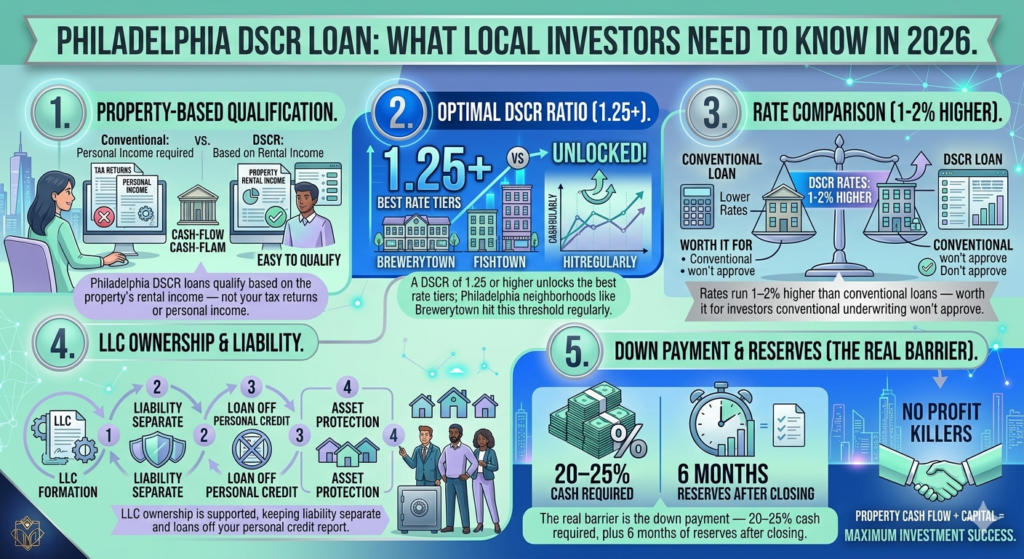
DSCR stands for Debt Service Coverage Ratio. A DSCR loan is a non-QM (non-qualified mortgage) loan for real estate investors where approval is based on the property’s income — not the borrower’s personal income.
The lender doesn’t care what’s on your tax returns. They care whether the property can pay for itself. No income verification, no tax returns, no debt-to-income ratio required.
How the Math Works
The formula:
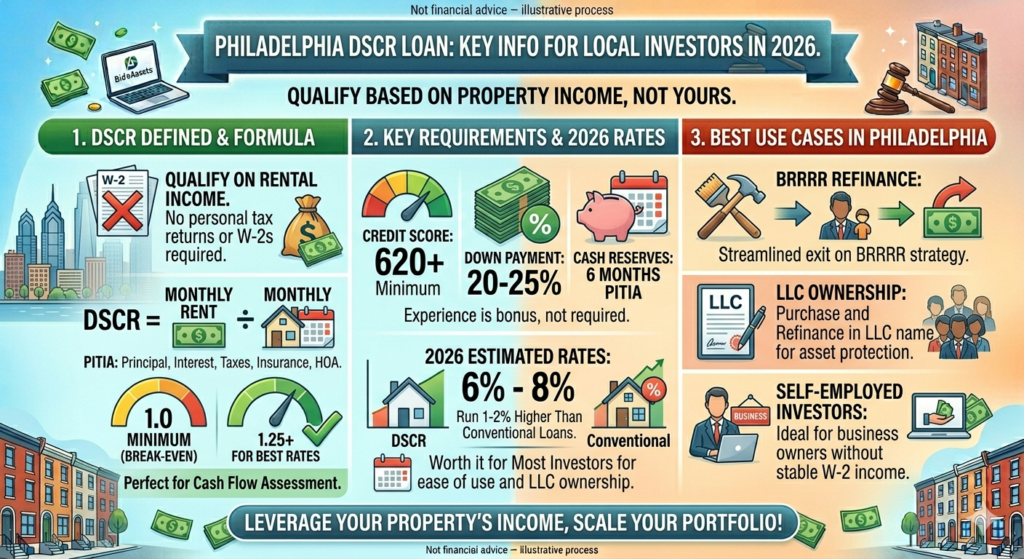
Monthly Rent ÷ Monthly PITIA = DSCR
PITIA = Principal + Interest + Taxes + Insurance + HOA (if applicable). The full monthly cost of owning the property.
A DSCR of 1.0 means rent exactly covers debt service. A DSCR of 1.25 means rent exceeds debt service by 25% — the threshold most lenders use to unlock their best rate tier.
Real Philadelphia DSCR loan examples:
- Property rents for $1,800/month / Monthly PITIA: $1,400 / DSCR = 1.28 ✅ qualifies, good rate tier
- Property rents for $1,200/month / Monthly PITIA: $1,400 / DSCR = 0.85 — some lenders will still do this, but more down and higher rate
Philadelphia’s rental market helps here. Germantown, Brewerytown, and West Philly rental demand has stayed strong — properties in those neighborhoods can often hit the 1.25 threshold that gets you the best terms.
Run your own numbers with the DSCR Calculator before you call a lender — know whether your deal qualifies before you pick up the phone.
What You Need to Qualify for a Philadelphia DSCR Loan in 2026
- Credit score: Minimum 640–660 to qualify; 700+ for optimal terms and higher LTV
- Down payment: 20–25% standard — no low-down-payment option exists
- Reserves: 6 months of PITIA payments in liquid reserves after closing
- Property type: Investment properties only — not primary residence, not fix-and-flip mid-renovation
The down payment is the binding constraint for most investors. Not income, not credit — just cash.
What Are the Rates?
Current Philadelphia DSCR loan rates in 2026 typically range from 6.0% to 8.0% depending on credit score, LTV, and property cash flow — roughly 1–2% higher than a standard conventional loan.
That’s the cost of skipping income documentation. For most investors, paying slightly more on a property you can actually buy beats a conventional rate on a property conventional underwriting won’t approve.
One thing most articles skip: most DSCR loans carry a prepayment penalty — typically a 5-year step-down. If you’re planning a BRRRR where you want to refinance quickly, ask about prepayment terms before you commit.
Why a Philadelphia DSCR Loan Makes Particular Sense Here
Philadelphia has a few characteristics that make DSCR loans especially relevant:
The price point works. Philadelphia properties in Germantown, Brewerytown, and Port Richmond frequently fall in the $150k–$250k range — well within DSCR loan minimums and far below the jumbo threshold.
Rental demand is steady. Philadelphia has a large renter population. Strong demand means your DSCR math is more likely to work — you can get the rent the appraiser needs to see.
Self-employed investors are common here. A lot of people doing deals in Philadelphia run their own businesses, not W-2s. Philadelphia DSCR loan underwriting was built for exactly this situation.
LLC ownership is supported. You can take out a DSCR loan in an LLC’s name to protect personal assets and keep the loan off your personal credit report — a big deal for anyone building a portfolio.
Philadelphia DSCR Loan and BRRRR: The Connection
If you’re doing a BRRRR deal — buy, rehab, rent, refinance, repeat — a Philadelphia DSCR loan is often the refinance tool at the end.
After a rehab, you’ve added value and want to pull cash out. But if your personal income looks low on paper, conventional lenders won’t give you the cash-out refi you need. DSCR doesn’t care. Some lenders allow refinancing as soon as the rehab is complete — without the 6-month seasoning period conventional lenders require. Show the lender a signed lease, and you refinance based on the new rental income.
That’s the BRRRR cycle working the way it’s supposed to.
Use the DSCR Loan Qualifier to see whether your deal and your credit profile line up before you start shopping lenders.
The Honest Downside
A Philadelphia DSCR loan is a great tool — but not magic.
The down payment is real. 20–25% on a $200k Philadelphia property is $40–50k cash, before closing costs and reserves. If you don’t have that, DSCR doesn’t solve your problem.
The rate premium adds up. On a $180k loan, the difference between 6.5% and 8% is about $175/month — over $10,000 across five years. Still worth it for most investors, but don’t ignore it.
The property has to actually cash flow. Philadelphia property taxes can be significant, especially after a post-renovation reassessment. Run the full PITIA number — not just principal and interest — before you assume your DSCR works.
Who a Philadelphia DSCR Loan Is Right For
Self-employed investors. Freelancers. People who’ve maxed out conventional financing at 10 properties. Investors who hold properties in LLCs. Anyone whose tax returns don’t reflect their actual financial strength.
If that sounds like you — and honestly, it sounds like a lot of Philadelphia investors — understanding DSCR before your next deal matters. Not after you’ve already been turned down by a conventional lender.
Not financial advice — just someone doing a lot of research and asking a lot of questions.