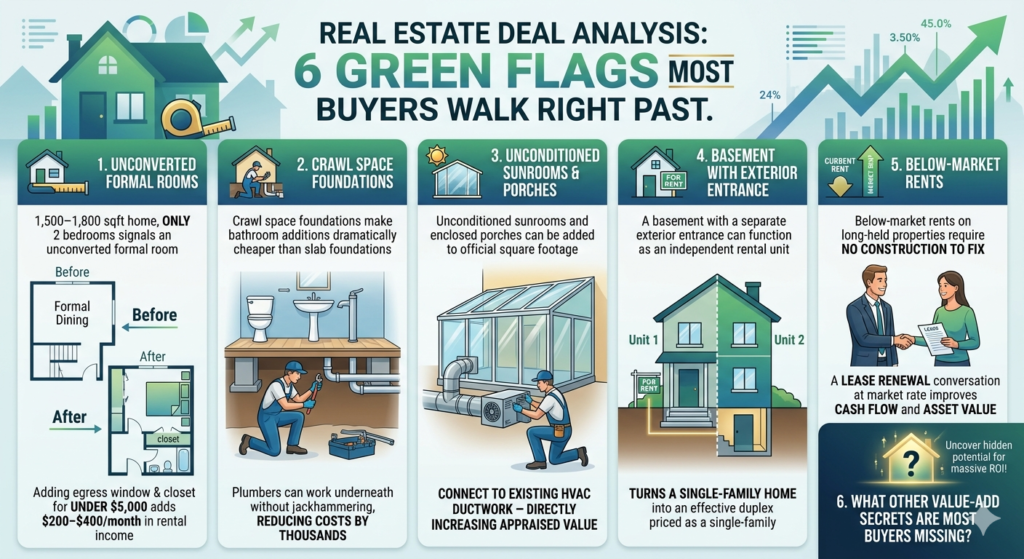
Real estate deal analysis that actually finds margin isn’t about finding the cheapest property — it’s about finding properties where you can create value with minimal dollars.
Most buyers look at a property and see what it is. The investors who consistently find good deals look at the same property and see what it could be. Here are the six green flags I’ve learned to screen for before I make any offer.
Real Estate Deal Analysis Green Flag #1: Wrong Bedroom Count for the Square Footage
The single highest-return improvement in residential real estate is often adding a bedroom — and the opportunity shows up in the listing data before you ever visit the property.
Look for homes with square footage that doesn’t match the bedroom count. A 1,500–1,800 square foot home with only two bedrooms is a signal. That extra space is probably being used as a formal living room, formal dining room, or an oversized laundry area — rooms that modern buyers and renters don’t value the way they used to.
How to convert it: To count as a legal bedroom, the room needs two things — an egress window (a window large enough to escape through in an emergency) and a closet. That’s it. In many cases, adding a closet and confirming egress window compliance is a sub-$5,000 renovation that adds $200–$400/month in rental income or meaningfully increases resale value.
The real estate deal analysis here is simple: find the gap between what the property currently is and what it could be with a framing wall and a door.
Real Estate Deal Analysis Green Flag #2: Shared Bathrooms Throughout
Bathroom count is one of the most consistent value drivers in residential real estate — both for resale and for rental income. A house where every bedroom shares a single common bathroom is priced to reflect that limitation. It’s also an opportunity.
The crawl space advantage: If the property sits on a crawl space foundation rather than a concrete slab, plumbing is dramatically easier and cheaper to run. A crawl space lets plumbers work underneath the floor without jackhammering concrete — which can reduce the cost of adding a bathroom by thousands of dollars.
The split bathroom play: Look for large shared bathrooms. A single oversized bathroom can often be split into two smaller bathrooms — one accessible from the hallway, one accessible only from the master bedroom — effectively creating a primary suite without moving walls.
In your real estate deal analysis, a property without a primary suite in a market where buyers expect one is a negotiating opportunity hiding in the listing description.
Real Estate Deal Analysis Green Flag #3: Unconditioned Square Footage
Property value is calculated on heated and cooled square footage. Space that exists under the roof but isn’t conditioned doesn’t count — and that’s where the opportunity lives.
What to look for: Sunrooms, enclosed porches, reading rooms, and converted spaces that were added to the home but never connected to the HVAC system. These show up as finished-looking spaces that aren’t included in the official square footage.
How to capture the value: If the space already has insulated exterior walls, connecting it to the existing HVAC system can be as simple as extending a duct run and adding a register. That connection — done properly and permitted — adds the space to the official heated square footage, which flows directly into the appraised value.
Your real estate deal analysis should flag any property where the visual square footage doesn’t match the listed square footage. That gap is worth investigating.
Real Estate Deal Analysis Green Flag #4: Unfinished Basement With Separate Entrance
A basement with its own exterior entrance is one of the most underpriced features in residential real estate — because most buyers don’t know what to do with it. Investors do.
A separate entrance means the basement can function as an independent unit. House hacking — living in one part of a property while renting another — becomes possible without sharing an entrance with your tenant. That changes the economics of the entire acquisition.
What to verify in your real estate deal analysis:
- Is there sufficient ceiling height? Most jurisdictions require 7–8 feet minimum for habitable space
- Does local zoning allow a second unit or accessory dwelling unit (ADU)?
- What’s the permitting process for converting the basement to a legal rental unit?
A single-family home with a legal basement apartment is effectively a duplex — and it’s often priced as a single-family home.
Real Estate Deal Analysis Green Flag #5: Oversized Lot or Adjacent Vacant Parcel
When a property sits on more land than its neighbors, or when the seller also owns an adjacent vacant parcel, there’s potential value that most buyers completely ignore.
The lot split strategy: If local zoning allows it, an oversized lot can be subdivided — the original house stays on one parcel, and the extra land becomes a separate buildable lot that can be sold or developed independently.
The critical real estate deal analysis rule: The numbers on the original property have to work without counting on the lot split. If you need the lot sale to make the deal pencil, you’re taking on development risk in addition to acquisition risk. The lot split should be upside — not the reason you bought.
In Philadelphia’s older neighborhoods, this comes up occasionally with corner lots or properties where the previous owner acquired adjacent land over time. Worth checking the parcel boundaries on every property you analyze seriously.
Real Estate Deal Analysis Green Flag #6: Below-Market Rents
This is the most overlooked value-add opportunity in real estate — and it shows up on the rent roll, not the inspection report.
Long-term landlords frequently let rents stagnate. A property that’s been owned by the same family for 20 years might have tenants paying $800/month in a market where comparable units rent for $1,200. The landlord never raised rents because the tenants are nice people and it felt uncomfortable.
Why this matters for your real estate deal analysis:
In commercial real estate, property value is calculated directly from income — NOI ÷ Cap Rate = Value. Even in residential multifamily, appraisers and buyers account for rent levels. A property with below-market rents is priced to reflect current income, not potential income.
When you buy it and bring rents to market at the next lease renewal, you’ve increased the cash flow and the asset value without touching a wall.
According to BiggerPockets, below-market rents on stabilized multifamily properties represent one of the most consistent value-add opportunities available — precisely because the improvement requires no construction, no permits, and no contractors, just a lease renewal conversation.
Putting Real Estate Deal Analysis Together
These six green flags share a common theme: they’re features that show up in the data before you visit the property.
- Wrong bedroom-to-square-footage ratio → listing data
- All shared bathrooms → listing data
- Official vs visual square footage gap → listing data
- Basement with separate entrance → listing photos and description
- Oversized lot or adjacent parcel → county GIS records
- Below-market rents → rent roll or rental history
The real estate deal analysis that finds margin starts at your desk, not at the property. By the time you’re scheduling a showing, you should already know which green flags are present and what the value-add play looks like.
Use the Philly Flip Profit Calculator to model any of these value-add scenarios before you make an offer — plug in your estimated post-improvement ARV against the current asking price to see if the margin is actually there.
Not financial advice — just someone doing a lot of research and asking a lot of questions.