I’ve been going back and forth on this one.
One expert tells me: “By the time it hits Zillow, the deal is gone. You need off-market leads.”
Another expert tells me: “Zillow is the best free motivated seller tool nobody’s using. Just search the right keywords.”
Same platform. Completely opposite advice. And I’m sitting here trying to figure out who’s right.
After digging into both sides, here’s what I actually think.
Why the “Zillow Is Dead” Crowd Has a Point
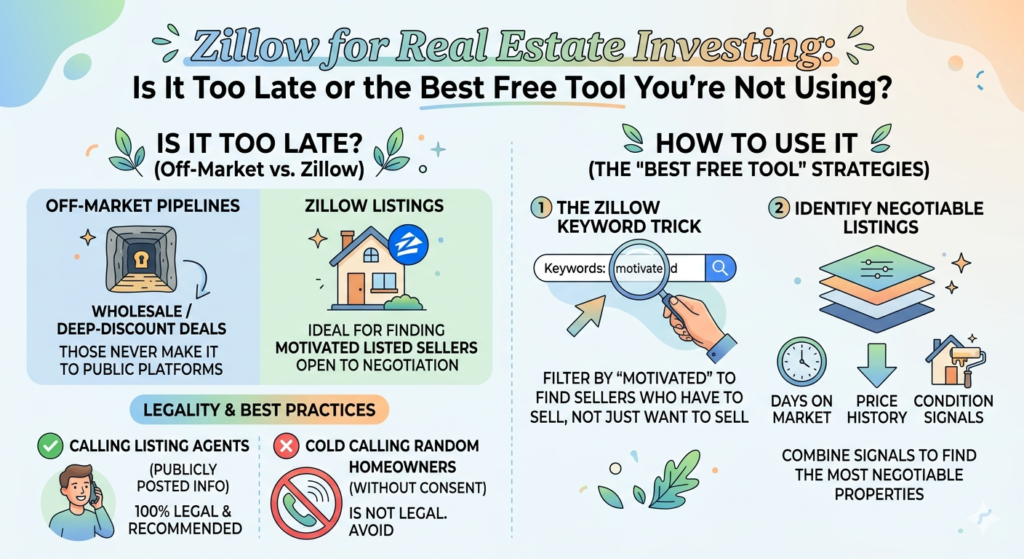
The investors who say Zillow is too late are usually talking about a specific type of deal — heavily discounted, off-market, 30-40% below market value.
They’re right that those deals don’t show up on Zillow. By the time a truly distressed property hits any public listing platform, wholesalers and their buyer networks have already seen it. The best deals in that category get snapped up before they’re ever publicly listed.
If you’re trying to find a property at 65 cents on the dollar — the kind of deal that makes a BRRRR or a wholesale flip work — Zillow is probably not your primary tool. You need wholesaler relationships, direct mail, driving for dollars, or county records.
That’s a real limitation. And it’s worth knowing upfront.
Why the “Zillow Keyword Trick” Crowd Also Has a Point
Here’s what the other side is actually saying — and it’s more nuanced than it sounds.
They’re not claiming Zillow will find you a 40% below-market deal. They’re saying Zillow can find you motivated sellers who are already listed — sellers who need to move, have been sitting on the market too long, and are psychologically ready to negotiate.
Here’s the specific tactic:
Go to Zillow. Search your target area. Open the filters (More filters). Find the Keywords field. Type “motivated”.
What comes back are listings where the agent has written “motivated seller” in the property description. These are sellers who:
- Need to sell fast (job relocation, divorce, financial pressure)
- Have already been on the market too long
- Are more open to creative offers or below-asking negotiations
This isn’t a guarantee of a deal. But it’s a filter that separates sellers who want to sell from sellers who have to sell. And that distinction matters.
The Red Flags to Look For (Inside the Zillow Listing)
Once you’ve filtered for “motivated,” here’s what to look at:
Days on Market A property that’s been sitting for 180+ days has a seller who’s been through the emotional cycle — hope, frustration, desperation. Their negotiating position is very different from a seller who listed last week.
Price History Click on “Price History” on any Zillow listing. If you see a property that started at $624,000 and has been reduced to $545,000 — that’s $79,000 in price cuts. That seller is telling you something. They need to move.
Condition vs. Price If a listing shows clearly dated interiors — old carpet, 1990s kitchen, deferred maintenance — and the seller hasn’t bothered to fix any of it before listing, that’s a signal. They either can’t afford to fix it, don’t want to deal with it, or just want out. All three create negotiating opportunity.
The Cold Calling Question: What’s Actually Legal
This came up in the “Zillow keyword” strategy and it’s worth addressing directly.
Cold calling and unsolicited text messaging are regulated by the Telephone Consumer Protection Act (TCPA). If you’re randomly calling homeowners from a list — especially using automated dialers or texting without consent — you’re in legally risky territory. People on the Do Not Call registry have explicit protections, and violations can result in significant fines.
Calling a listing agent whose contact information is publicly posted on Zillow? Completely legal. That’s exactly what the contact information is there for. You’re not cold calling — you’re responding to a public advertisement.
This is why the Zillow keyword strategy sidesteps the cold calling debate entirely. You’re not hunting down homeowners through skip tracing. You’re calling agents who are actively soliciting buyers.
So Who’s Right?
Both of them — for different goals.
If your goal is wholesale deals or deep-discount acquisitions: Zillow is not your primary source. You need off-market pipelines — wholesalers, expired listings, direct mail, tax sale lists. The deals that work at those margins don’t sit on public platforms.
If your goal is finding motivated sellers who are open to negotiation: The Zillow keyword trick is genuinely useful and completely free. It won’t find you 40-cents-on-the-dollar deals. But it can find sellers who are ready to talk, ready to negotiate, and ready to move faster than the market average.
The mistake is treating these as competing strategies. They’re actually complementary. Your off-market pipeline finds the deeply discounted deals. Your Zillow keyword search finds the motivated listed sellers who might accept creative terms or a below-asking offer.
How to Actually Use This in Philadelphia
Open Zillow. Type Philadelphia. Go to More Filters. Keywords → type “motivated.”
Then layer on:
- Sort by “Days on Zillow” (longest first)
- Check Price History on anything that catches your eye
- Look for properties with visible deferred maintenance
You’re not looking for a miracle deal. You’re looking for a seller whose situation has changed since they listed — and who might be open to a conversation that a buyer who showed up on day one wouldn’t have had.
Call the listing agent. Ask about the seller’s timeline. Ask if there’s flexibility on price or terms. You’re not making an offer on the phone — you’re qualifying whether it’s worth making one.
That’s it. Free. Legal. Takes about an hour to run the search and make a few calls.
Will every call lead somewhere? No. The numbers game here is real — you might need to contact 10-15 listings to find one that has genuine flexibility. But the cost of entry is zero, and the upside is a deal at better terms than you’d get from a seller who listed yesterday.
Not financial advice — just someone doing a lot of research and asking a lot of questions.