
Flip vs. Sell As Is: A $350K Pennsylvania House — Which Strategy Makes More Money?
I came across a video recently that stopped me mid-scroll.
A real estate investor bought a house in Glenside, Pennsylvania — right outside Philadelphia — for $350,000. The place needed everything. Floors, drywall, electrical, HVAC, ceilings peeling off the walls. The kind of house that makes most people walk away.
But instead of just deciding what to do with it, he laid out both options with real numbers. The flip vs sell as is question comes up in every deal — and most people get it wrong.
The Property
- Location: Glenside, PA (Montgomery County — right outside Philadelphia)
- Purchase price: $350,000
- Condition: Full gut renovation needed
- Estimated repair costs: $130,000–$140,000
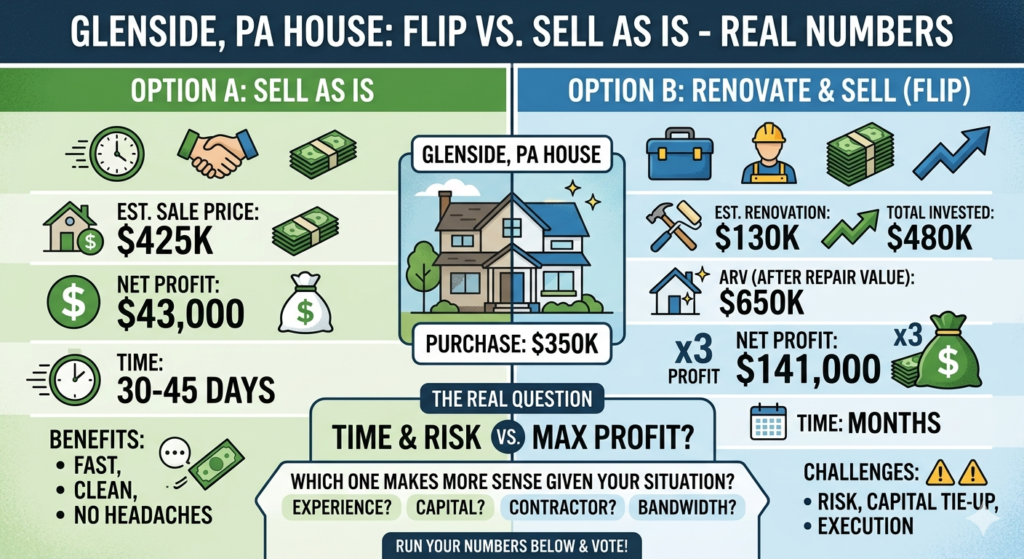
Option A: Sell As Is
Don’t touch it. List it in current condition and let another investor deal with the renovation.
- Expected sale price: $425,000
- Net profit after costs: $43,000
Quick. Clean. No renovation headaches. Money in hand in 30–45 days.
Option B: Flip vs Sell As Is — The Full Renovation Route
Put in the work, raise the value, sell at full retail.
- Purchase price: $350,000
- Renovation costs: $130,000
- Total invested: $480,000
- ARV (After Repair Value): $650,000
- Net profit after costs: $141,000
More than triple the profit of Option A.
Want to stress-test these numbers before you commit? The Sell vs. Keep Calculator can help you think through both sides of this decision.
So Which One Is Right?
On paper, Option B wins by a landslide. $141K vs $43K — the math seems obvious.
But the flip vs sell as is decision isn’t just about profit on paper. Here’s what the numbers don’t show:
Time. A full gut renovation takes months. Option A closes in weeks. Time is money, especially if you have a hard money loan charging you interest every day.
Risk. Renovation budgets almost never stay on budget. That $130K estimate could easily become $160K if something unexpected shows up — and in an older Pennsylvania house, something always shows up.
Execution. You need a reliable GC, permits, inspections, and the bandwidth to manage the whole project. Option B requires a lot more from you.
Capital. Option B ties up $480,000 for months. Option A frees up your cash faster so you can move to the next deal.
Before committing to either route, run your ARV and repair numbers through the Philly Flip Profit Calculator — especially if you’re working with a hard money loan on a tight timeline.
The Real Question Isn’t Which Makes More Money
It’s: which one makes more sense given your situation?
The flip vs sell as is question really comes down to three things — your experience level, your available capital, and your risk tolerance.
If you’re experienced, have a trusted contractor, and can manage the timeline — Option B is the obvious choice. $141K profit on a single deal is life-changing money.
If you’re earlier in the game, need capital back quickly, or don’t have the bandwidth to manage a full renovation — Option B’s extra $98K might not be worth the risk and stress.
According to the National Association of Realtors, the average time to complete a full renovation flip is 6–12 months depending on scope. That’s 6–12 months of carrying costs, contractor management, and market risk on top of your renovation budget.
What Would I Do?
Honestly? Looking at this from the outside, Option B makes sense if the $650K ARV is solid. Glenside is a strong market — Montgomery County buyers pay for renovated homes.
But I’d want to verify those comps hard before committing to a $130K renovation budget. And I’d want a contractor lined up before I closed — not after.
The flip vs sell as is choice changes completely depending on your timeline and who’s swinging the hammer. Run the numbers below and see what this deal looks like from your angle.
Not financial advice — just someone doing a lot of research and asking a lot of questions.