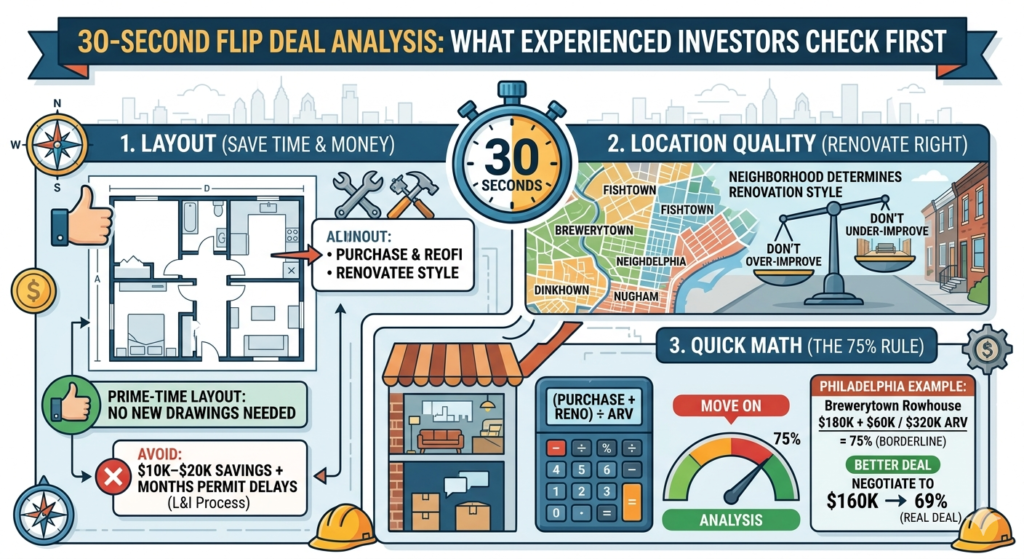
Analyze flip deal the way experienced investors do — not with spreadsheets, but with pattern recognition. Most beginners spend hours on a property. Full-time flippers make a decision in about 30 seconds.
I came across a video where a seasoned house flipper broke down exactly what he looks at first — and I applied the same framework to what I’m seeing here in Philadelphia.
Here’s how to analyze flip deal opportunities the way experienced investors actually do it.
Step 1: Layout — The First Thing You Need to Analyze Flip Deal Potential
Before ARV. Before comps. Before anything else — layout.
Specifically: does this house need architectural drawings or not?
This sounds minor but it’s actually massive. In most mid-Atlantic markets including Philadelphia and New Jersey, changing the layout — moving walls, adding a bedroom, reconfiguring a bathroom — requires architectural drawings, permits, and sometimes structural engineering reports.
That process can add:
- $5,000–$15,000 in design and engineering fees
- 2–4 months of delays waiting for permits
- Massive uncertainty if the city pushes back
A house with a prime-time layout — meaning the existing floor plan already works for the market — needs none of that. You go straight to cosmetic renovation. Kitchens, bathrooms, floors, paint. Fast, predictable, and cheaper.
In Philadelphia, this matters even more because L&I can be slow. Any project requiring structural permits adds time you might not have when you’re paying hard money interest by the day.
What to look for when you analyze flip deal layouts in Philadelphia: 3–4 bedroom rowhouses where the layout already makes sense — living room in front, kitchen in back, bedrooms upstairs. The ones that need walls moved or staircases relocated? Budget an extra $10K–$20K and two extra months minimum.
Step 2: Location — What the Neighborhood Tells You Before You Analyze Flip Deal Numbers
The neighborhood tells you what the renovation needs to look like. Every time you analyze flip deal potential, location determines your finish level.
High-income area → buyers expect luxury finishes → you need to deliver or you’ll sit on the market.
Working-class area → buyers want clean and functional → over-improving kills your margin.
In Philadelphia, this translates directly:
| Neighborhood | Buyer Expectation | Renovation Style |
|---|---|---|
| Rittenhouse, Fairmount | High — luxury finishes | Quartz, custom tile, high-end fixtures |
| Brewerytown, Fishtown | Medium-high — modern | Clean, contemporary, good appliances |
| Germantown, West Philly | Medium — clean and updated | Solid finishes, nothing extravagant |
| Kensington (transitional) | Be careful | Know your buyer before you renovate |
One of the most expensive mistakes a new flipper makes is renovating to their own taste instead of the neighborhood’s expectation. Beautifully renovated homes sit for months because the finishes were too high-end for the block — or too cheap for the zip code.
Step 3: The 30-Second Math to Analyze Flip Deal Viability
After layout and location, here’s the quick calculation every experienced investor uses to analyze flip deal viability:
- What’s the ARV for this neighborhood?
- What’s a realistic renovation budget?
- What’s the purchase price?
If (purchase price + renovation) ÷ ARV is above 75% — move on immediately. The deal doesn’t work.
If it’s at 65% or below — it goes on the short list for deeper analysis.
Philadelphia example:
You see a rowhouse in Brewerytown listed at $180,000. Needs a full renovation. Comparable renovated homes are selling at $320,000.
- Renovation estimate: $60,000
- Total in: $240,000
- ARV: $320,000
- Ratio: $240K ÷ $320K = 75%
Borderline. Worth a closer look, but not exciting. If you could get it for $160,000? Now you’re at 69%. That’s a deal worth pursuing when you analyze flip deal potential in this neighborhood.
According to BiggerPockets, the 70% rule is the most widely used quick filter in house flipping — experienced investors use it to analyze flip deal potential and eliminate bad deals in seconds, not hours.
The Full 30-Second Framework to Analyze Flip Deal Opportunities in Philadelphia
Next time you’re scrolling Zillow or driving through a neighborhood, here’s your quick filter to analyze flip deal potential:
Step 1 — Layout check (10 seconds) Does the floor plan work as-is? Or does it need structural changes?
Step 2 — Location check (10 seconds) What kind of buyers are in this neighborhood? What do they expect from a renovated home?
Step 3 — Quick math (10 seconds) (Asking price + estimated renovation) ÷ estimated ARV. Under 70%? Keep looking. Under 65%? Get excited.
If all three check out — then you dig deeper. Pull comps, get a contractor walkthrough, talk to a hard money lender.
If any one of them fails — move on. There will be another deal.
Every time you analyze flip deal opportunities consistently using this framework, your pattern recognition gets faster. The goal isn’t to spend hours on every deal. It’s to eliminate the bad ones in 30 seconds so you can focus on the ones worth pursuing.
Use the Philly Flip Profit Calculator to run the full numbers once a deal passes your 30-second analyze flip deal filter — before you make any offer.
Not financial advice — just someone doing a lot of research and asking a lot of questions.