Philadelphia Land Bank is one of the most underutilized opportunities in this city — and I walk past potential deals every single day in Germantown without most people knowing they exist.
I used to walk past boarded-up rowhouses thinking what a waste. Then I saw a video of a woman who does nothing but hunt for abandoned properties. She doesn’t look for listings. She doesn’t go to auctions. She just finds abandoned buildings, talks to the county, and walks away with the deed for almost nothing.
That sent me down a rabbit hole about the Philadelphia Land Bank — and what I found genuinely surprised me.
What Is the Philadelphia Land Bank?
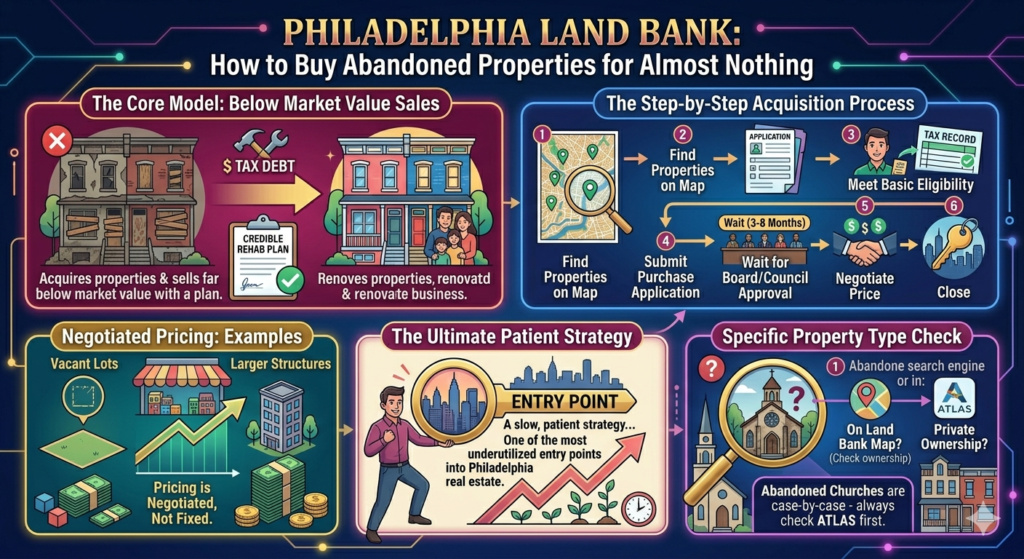
The Philadelphia Land Bank is a city-run agency that acquires vacant and tax-delinquent properties and then sells them — often at well below market value — to buyers who commit to fixing them up.
Think about it from the city’s perspective. An abandoned property attracts crime, drags down surrounding property values, costs the city money in code enforcement, and sits there generating zero tax revenue. The city wants these properties off its hands and back into productive use.
That’s where the Philadelphia Land Bank comes in. It acts as the middleman between problem properties and people who want to do something with them.
The Philadelphia Land Bank process is actually more accessible than most people realize — you don’t need a real estate license, you don’t need to be a developer, and you don’t need deep pockets to get started.
What Kind of Properties Does the Philadelphia Land Bank Have?
This is the part that blew my mind when I started digging.
It’s not just vacant lots. The Philadelphia Land Bank inventory includes rowhouses that have been abandoned for years, vacant lots that could be side yards, community gardens, or new construction sites, and larger structures like old church buildings and former school buildings sitting empty for decades.
If you’ve spent any time in Germantown, Kensington, or North Philly, you’ve walked past Philadelphia Land Bank inventory without knowing it. Entire blocks of it.
The properties come into the Philadelphia Land Bank’s possession primarily through tax sales — when a property owner stops paying taxes, the city eventually acquires the property and transfers it to the Land Bank.
Philadelphia Land Bank: The Step-by-Step Purchase Process
Step 1: Find available properties
Go to phillylandbank.org and click on the property map. You can see every parcel the Philadelphia Land Bank currently controls. Filter by neighborhood, lot size, or property type.
Not all of these properties are actively for sale at any given moment — some are earmarked for specific programs. But many are available for purchase applications.
Step 2: Submit a purchase application
Once you find a property you want, submit a formal application through the Philadelphia Land Bank’s website. The application asks you to explain what you plan to do with the property, your timeline for development or rehabilitation, and how you plan to finance the project.
You don’t need to have everything figured out perfectly, but you do need a credible plan. “I want to fix it up and rent it out” with some basic numbers attached is enough to get started.
Step 3: Meet the basic eligibility requirements
To be eligible to purchase from the Philadelphia Land Bank you need to:
- Have no outstanding tax debt with the city of Philadelphia
- Have no conflict of interest with city officials
- Be able to demonstrate you can actually execute your plan
No license required. No net worth minimum. If your taxes are current and your plan is credible, you’re in the running.
Step 4: Board approval and City Council approval
After your application is reviewed, it goes to the Philadelphia Land Bank’s Board of Directors for approval. Larger transactions also require City Council approval.
Realistically, budget 3 to 8 months from application to approval. It’s a government process. It moves slowly.
Step 5: Negotiate the price
The Philadelphia Land Bank doesn’t have a fixed price list. Pricing is negotiated based on the property’s condition, your intended use, and the Land Bank’s goals for that neighborhood.
For vacant lots, prices can be as low as a few hundred dollars. For larger structures in worse condition, you might pay a few thousand. Buying from the Philadelphia Land Bank almost always means paying a fraction of what you’d pay on the open market.
Step 6: Close and get your deed
Once approved and priced, you go through a standard closing process. You get a deed. The property is yours. Then the clock starts on your development timeline — the Philadelphia Land Bank will check in to make sure you’re actually doing what you said you’d do.
Philadelphia Land Bank and Abandoned Churches
Germantown alone has more abandoned church buildings than I can count. Beautiful old stone structures sitting empty, windows broken, roofs deteriorating.
Can you get those through the Philadelphia Land Bank?
Sometimes — but not always. It depends on who owns them.
If a church closed and the congregation stopped paying taxes, the property may have gone through tax sale and ended up with the Philadelphia Land Bank. In that case, yes — it could be available through the same process above.
But many abandoned churches are still technically owned by the diocese or a religious organization that just hasn’t done anything with the building. In that case, the property isn’t in the Philadelphia Land Bank at all — you’d need to track down the religious organization directly and negotiate with them.
The only way to know for sure is to look up the property on Philadelphia’s Atlas site (atlas.phila.gov), check the ownership record, and see who the grantor is.
The Philadelphia Land Bank Reality Check
It isn’t a way to snap up a property in a week. The timeline is long. Government approvals take time.
It isn’t completely free. Even if the land costs almost nothing, you’re still on the hook for rehab costs, permits, inspections, and eventually taxes once you own it.
It isn’t a passive strategy. The Philadelphia Land Bank is giving you a deal because they want that property fixed up and contributing to the neighborhood. If you’re not serious about following through, this isn’t the right play.
But for someone who’s willing to be patient, has a plan, and wants to get into Philadelphia real estate without needing a massive down payment — the Philadelphia Land Bank is one of the most underutilized opportunities in this city.
According to HUD.gov, land banks like the Philadelphia Land Bank are a federally recognized tool for returning vacant and abandoned properties to productive use — with cities that operate active land bank programs consistently showing lower blight rates and stronger neighborhood property value trajectories than comparable cities without them.
Use the Philly Flip Profit Calculator to run the numbers on any Philadelphia Land Bank property before you submit your application — plug in purchase price, renovation budget, and ARV to confirm the deal pencils before you commit to the development timeline.
Not financial advice — just someone doing a lot of research and asking a lot of questions.