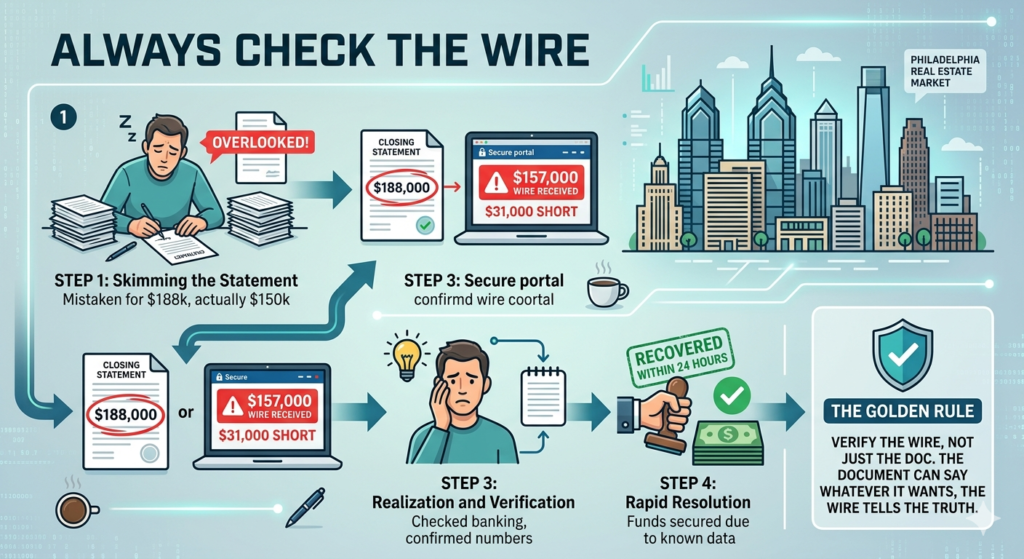
A real estate closing statement almost cost an experienced investor $40,000. Not a beginner. Someone with 31 units and over $4 million in real estate — someone who clearly knows what they’re doing.
If it can happen to him, it can happen to any of us.
Here’s What Went Down
He was closing on a property contracted at $110,000. During inspections, a sewer line issue came up — $5,800 in damage. He negotiated the price down to $104,000. He also had a hard money loan in place for $150,000 to cover the purchase and renovation.
At closing, the real estate closing statement came through.
He was busy. Thirty-one units busy. Multiple deals running simultaneously busy. So when the document landed in his inbox, he did what a lot of people do when they’re stretched thin — he skimmed it and signed.
The real estate closing statement said he owed $188,000 at closing.
That number was wrong. Badly wrong. But he didn’t catch it in the moment.
He found out something was off when the wire hit his account. Instead of receiving the $40,000 he was expecting — the difference between his hard money loan and what he owed at closing — he got $9,000.
Thirty-one thousand dollars short.
What Happened Next
Here’s the part that’s actually reassuring: he caught it fast.
Because he knew his numbers cold — what he’d contracted for, what the loan amount was, what he should have walked away with — the second that wire hit, he knew something was wrong.
He made calls. The wholesaler got involved. The title company traced the error. The money was returned, and within 24 hours, he had the correct amount wired to his account.
Crisis averted. But just barely.
The Three Lines That Changed How I Think About Closings
“When you’re moving fast, mistakes happen. The question is whether you catch them.”
He wasn’t saying slow down — he was saying stay sharp. Know your numbers well enough that something off by $31,000 feels wrong immediately, not three weeks later when you’re trying to reconcile your accounts.
“Always check the wire. The document can say whatever it wants — the wire tells the truth.”
The real estate closing statement is just paper. The wire is real money moving in the real world. When you close on a property, don’t just wait for the confirmation email — verify the actual amount that landed. Every time.
“Read your closing statements. Every line. Every time.”
Not most lines. Not the summary page. Every single line. Even when you’re tired. Even when the title company seems perfectly competent and you’ve worked with them before.
What Is a Real Estate Closing Statement, Anyway?
Since I’m still learning this myself, I went back to basics after watching this video.
A real estate closing statement — sometimes called a HUD-1 or Closing Disclosure — breaks down every dollar involved in a transaction. It shows:
- The purchase price
- Your loan amount
- Any credits or adjustments (like that sewer line negotiation)
- Closing costs, title fees, prorations
- The final amount you’re receiving or paying
It can be several pages long. There are a lot of line items. And apparently, errors happen — even at professional title companies with experienced staff.
The investor in this video didn’t catch the error on the document. He caught it on the wire. That’s one layer of protection — but ideally, you catch it before money moves at all.
According to the Consumer Financial Protection Bureau, buyers have the right to receive their Closing Disclosure at least three business days before closing — specifically so they have time to review every line before signing.
Real Estate Closing Statement Quirks in Philadelphia
Philadelphia real estate transactions have their own closing cost complexities — realty transfer tax, city wage tax prorations, water and sewer lien searches, and more.
There are more line items than you might expect on a Philadelphia real estate closing statement. More places for something to be entered incorrectly. More reasons to read every single line before you sign anything.
If you’re new to this and you’re not sure what you’re looking at — ask. Ask your real estate attorney. Ask your agent. Ask the title company to walk you through it line by line before closing day. That’s not being difficult. That’s being a competent buyer.
Before you get to closing, use the Philly Flip Profit Calculator to make sure your projected numbers are locked in — so the moment something looks off on the real estate closing statement, you know it immediately.
Not financial advice — just someone doing a lot of research and asking a lot of questions.