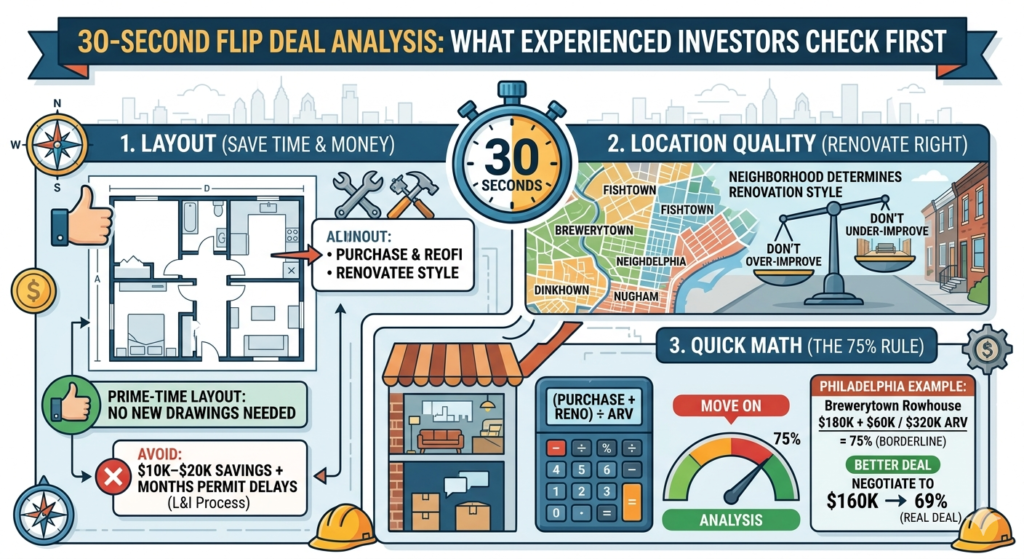
Most beginners spend hours analyzing a deal. Experienced flippers make a decision in about 30 seconds.
That’s not recklessness — that’s pattern recognition. They’ve seen enough deals that they know immediately what matters and what doesn’t. I came across a video where a full-time house flipper broke down exactly what he looks at in the first 30 seconds of evaluating a property, and I applied it to what I’m seeing here in Philadelphia.
Here’s the framework.
The First Thing They Look At: Layout
Before ARV. Before comps. Before anything else — layout.
Specifically: does this house need architectural drawings or not?
This sounds like a minor detail but it’s actually massive. In most mid-Atlantic markets including Philadelphia and New Jersey, changing the layout of a house — moving walls, adding a bedroom, reconfiguring a bathroom — requires architectural drawings, permits, and sometimes structural engineering reports.
That process can add:
- $5,000–$15,000 in design and engineering fees
- 2–4 months of delays waiting for permits
- Massive uncertainty if the city pushes back
A house with a “prime-time layout” — meaning the existing floor plan already works for the market — needs none of that. You go straight to cosmetic renovation. Kitchens, bathrooms, floors, paint. Fast, predictable, and cheaper.
In Philadelphia, this matters even more because L&I (Licenses & Inspections) can be slow. Any project that requires structural permits adds time you might not have if you’re paying hard money interest by the day.
What to look for in Philadelphia: 3–4 bedroom rowhouses where the layout already makes sense — living room in front, kitchen in back, bedrooms upstairs. These are your prime-time layouts. The ones that need walls moved or staircases relocated? Budget an extra $10K–$20K and two extra months minimum.
The Second Thing: Location Quality
The flipper in the video looked at Princeton Junction, New Jersey and immediately called it a “prime-time location” — good neighborhood, residents with good jobs and good cars, strong demand for quality homes.
His point: the neighborhood tells you what the renovation needs to look like.
High-income area → buyers expect luxury finishes → you need to deliver or you’ll sit on the market.
Working-class area → buyers want clean and functional → over-improving kills your margin.
In Philadelphia, this translates directly:
| Neighborhood | Buyer Expectation | Renovation Style |
|---|---|---|
| Rittenhouse, Fairmount | High — luxury finishes | Quartz, custom tile, high-end fixtures |
| Brewerytown, Fishtown | Medium-high — modern but not over the top | Clean, contemporary, good appliances |
| Germantown, West Philly | Medium — clean and updated | Solid finishes, nothing extravagant |
| Kensington (transitional) | Be careful | Know your buyer before you renovate |
One of the most expensive mistakes a new flipper makes is renovating to their own taste instead of the neighborhood’s expectation. I’ve seen beautifully renovated homes sit for months because the finishes were too high-end for the block — or too cheap for the zip code.
The Third Thing: Does the Math Work in 30 Seconds?
After layout and location, experienced flippers do a quick mental calculation:
- What’s the ARV for this neighborhood?
- What’s a realistic renovation budget?
- What’s the purchase price?
If (purchase price + renovation) ÷ ARV is above 70–75%, they move on immediately. No further analysis needed. The deal doesn’t work.
If it’s at 65% or below, it goes on the short list for deeper analysis.
That’s it. Thirty seconds.
Philadelphia example:
You see a rowhouse in Brewerytown listed at $180,000. Needs a full renovation — kitchen, bathrooms, floors. Comparable renovated homes are selling at $320,000.
Quick math:
- Renovation estimate: $60,000
- Total in: $240,000
- ARV: $320,000
- Ratio: $240K ÷ $320K = 75%
That’s borderline. Worth a closer look, but not exciting. If you could get it for $160,000? Now you’re at 69%. That’s a deal worth pursuing.
The 30-Second Framework Applied to Philadelphia
Next time you’re scrolling Zillow or driving through a neighborhood, here’s your quick filter:
Step 1 — Layout check (10 seconds) Does the floor plan work as-is? Or does it need structural changes?
Step 2 — Location check (10 seconds) What kind of buyers are in this neighborhood? What do they expect?
Step 3 — Quick math (10 seconds) (Asking price + estimated renovation) ÷ estimated ARV. Under 70%? Keep looking. Under 65%? Get excited.
If all three check out — then you dig deeper. Pull comps, get a contractor walkthrough, talk to a hard money lender.
If any one of them fails — move on. There will be another deal.
Why This Matters for Beginners
When I first started looking at properties, I was spending hours on deals that experienced investors would have eliminated in 30 seconds.
The layout was wrong. Or the location didn’t match the renovation I was imagining. Or the quick math was obviously off.
Building this filter saves you from the most expensive thing in real estate investing — wasted time and emotional attachment to a bad deal.
The deal you don’t do is just as important as the deal you do.
Not financial advice — just someone doing a lot of research and asking a lot of questions.